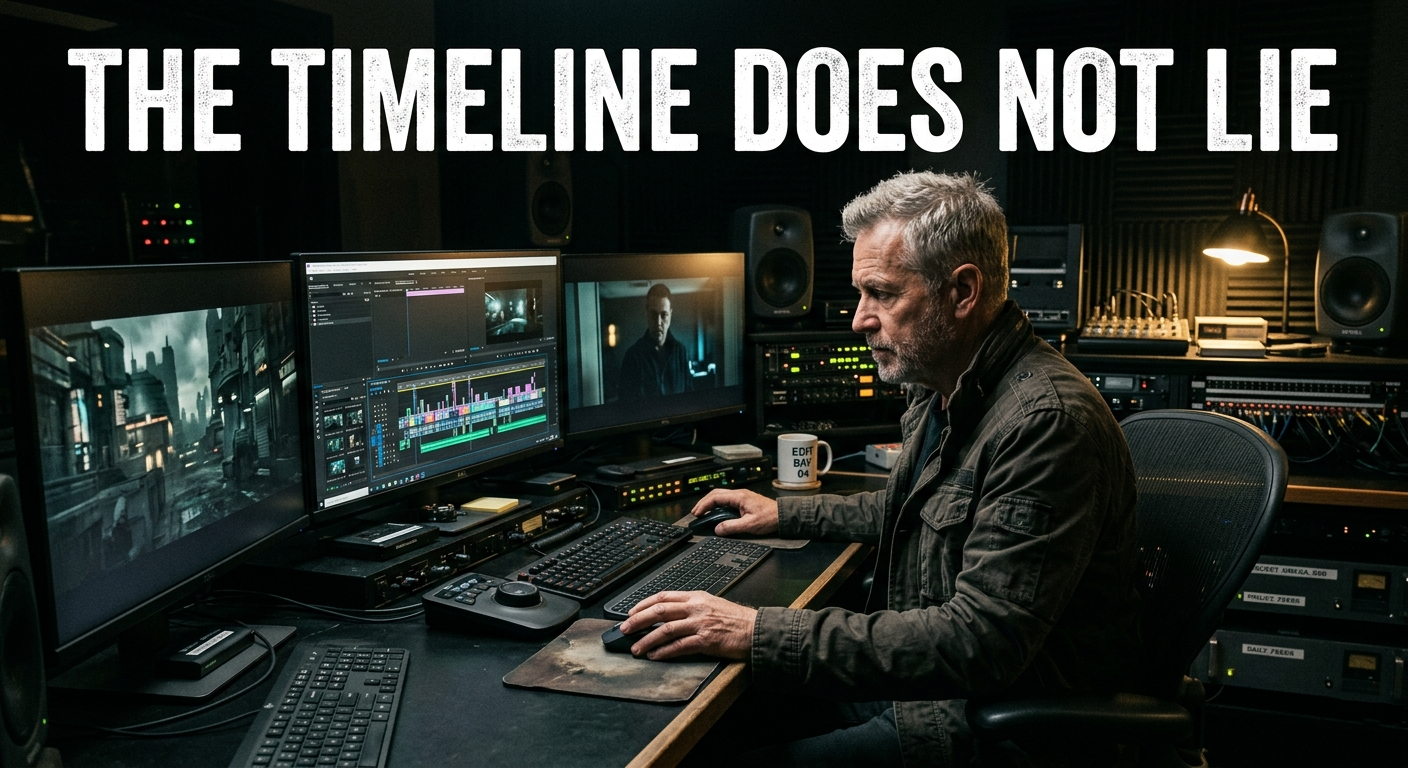
The editing room has always been a place of brutal honesty. It does not matter how much money was spent on set or how difficult the lighting setup was. If the shot does not serve the story, it gets cut. The rise of AI video generation has disrupted the production phase, but it has not changed the fundamental geometry of editing. It has only exposed who actually understands it.
Right now, the industry is split between two distinct workflows. There is the newcomer who treats AI like a magic trick, and there is the veteran who treats it like raw footage. The difference in their final output is staggering.
The Beginner Workflow: The Gallery of Miracles
When a newcomer sits down to edit AI video, they are usually operating under the spell of the generation process. They just spent three hours wrestling with prompts to get a flawless render of a cyberpunk city or a photorealistic actor. They treat their hard drive like an art gallery.
Their workflow is additive. They drag their favorite clips onto the timeline, placing them back to back. Because every clip looks like a masterpiece, they refuse to trim them. They let a character stare into the distance for a full five seconds because the fabric physics on the jacket look expensive. They build a sequence of beautiful, isolated moments that have no connective tissue.
The beginner is a curator. They are displaying the best outputs of the machine. But a slideshow of incredible images is not a film. It has no internal rhythm, no escalating tension, and no psychological grip on the audience.
The Veteran Workflow: The Discipline of the Cut
A veteran editor approaches an AI file exactly the way they approach a massive folder of raw ARRI footage. They do not care how hard the shot was to prompt. They only care about what happens when frame A collides with frame B.
The veteran workflow is subtractive. They know that AI models, especially when generating independent eight-second segments like Veo 3, do not inherently understand continuity. The engine does not know that the actor needs to look left to match the eye line of the previous shot. The engine does not understand that cutting on movement hides the slight digital artifacts in the motion blur.
The veteran editor brings the discipline of the Kuleshov effect to the latent space. They will take a stunning, photorealistic render and aggressively slice off the first three seconds because the pacing demands a faster entry. They will brutally delete a clip that took fifty attempts to generate if it breaks the emotional rhythm of the scene. They understand that the magic of cinema lives in the cut, not in the pixel density.
The Commercial Reality
This divide becomes a matter of survival in the B2B and agency world. Clients do not pay for gallery exhibitions. They pay for audience retention and commercial conversion.
If you are cutting a social branding video for a demanding fintech client like LeadGenHub, the stakes are entirely operational. The viewer on a social feed does not care about your prompt engineering. If the cut is slow, they scroll. The veteran editor structures the timeline to hook the eye in the first two seconds, using sound design, precise pacing, and ruthless trimming to drag the viewer through the message. The newcomer leaves the clips long to show off the visual fidelity, and the audience abandons the video out of boredom.
In real studio work, the AI is just the camera. The strategy, the pacing, and the taste must come from a human brain.
The True Craft
Prompting is a technical skill. Editing is a narrative discipline. The current wave of AI tools has democratized the ability to acquire beautiful footage. It has not democratized the ability to tell a story.
Anyone can sit in front of an engine and pull the lever until a gorgeous clip emerges. But building a world across a timeline requires a completely different mindset. It requires the willingness to destroy your own beautiful renders for the sake of the narrative. Beginners collect moments. Veterans construct films.