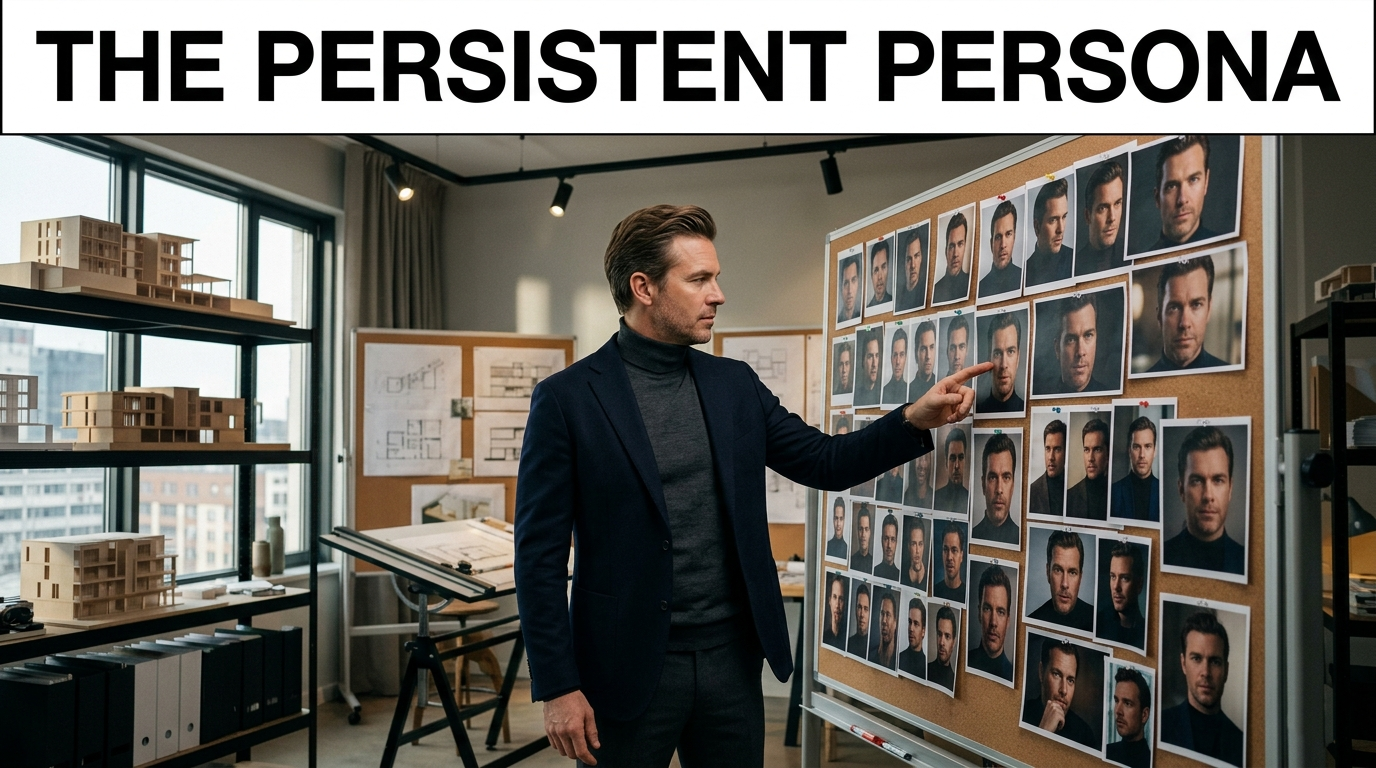
The Mascot Deficit
Brand equity is not built through novelty alone. It is built through memory. A familiar face, voice, posture, or emotional rhythm gives an audience something to recognize before the message is even processed. In B2B marketing, where purchase cycles are long and trust is earned through repeated exposure, that recognition carries commercial weight. A recurring spokesperson, brand character, or visual representative creates continuity across campaigns, product launches, industry events, investor communications, and sales enablement.
Traditional advertising understood this instinctively. The same recognizable figure could appear in multiple contexts, introducing a product, explaining a value proposition, reassuring a hesitant buyer, or embodying a category point of view. Repetition turned that figure into a memory asset. The audience did not need to rebuild trust from zero each time. Familiarity did part of the work.
Basic generative video breaks that system.
The default behavior of generative AI is invention. Each prompt tends to produce a new person, a new face, a new emotional presence, and a new visual identity. Even when the prompt describes the same professional archetype, the output often shifts: different jawline, different eyes, different age, different posture, different energy. What looks impressive in isolation becomes destructive in sequence. A brand may generate ten beautiful films, but if every film introduces a new stranger, none of them compound into a recognizable brand asset.
For a Chief Marketing Officer, that is not a visual issue. It is an equity issue. Random faces create random memory. Random memory does not scale.
The Anatomy of a Digital Actor
A professional digital actor is not merely prompted into existence. A professional digital actor is engineered.
The foundation is the character bible, a production document that treats the persona as a real cast member with fixed biological, emotional, and cinematic traits. This document defines the actor before generation begins. It does not stop at broad descriptions such as "confident executive" or "approachable expert." Those terms are too vague. A machine interprets vagueness statistically, producing an average of many possible people rather than one specific person.
A proper character bible defines bone structure: face shape, cheekbone height, brow weight, chin proportion, nose bridge, eye spacing, hairline, neck length, and shoulder posture. It defines skin behavior: texture, age markers, pores, freckles, under-eye detail, facial hair density, and how the face reacts under different lighting conditions. It defines wardrobe logic, not just clothing style, but the relationship between fabric, status, industry, and occasion.
Most importantly, it defines expression.
For recurring digital actors, micro-expressions are not decorative. They are part of the brand identity. A slight half-smile, a calm pause before speaking, a focused look toward the camera, a restrained nod, or a subtle lift in the eyebrow can become as recognizable as a logo treatment. These details determine whether the actor feels authoritative, warm, skeptical, technical, visionary, or reassuring.
The digital actor also requires behavioral boundaries. How much charisma is allowed? How much humor? How much urgency? Does the persona speak with boardroom restraint, founder intensity, analyst precision, or customer-success empathy? Without these limits, the same face may drift into different personalities across campaigns, which is just as damaging as a changing face. A persistent persona is therefore both visual and psychological. The face must remain stable, but the emotional contract must remain stable as well.
The Control Pipeline
Maintaining a digital actor across dozens of campaigns requires more than descriptive prompting. It requires a control pipeline designed to reduce randomness at every stage.
The first layer is structural conditioning. Before a final image or video sequence is rendered, the production team establishes the underlying geometry of the person. Facial proportions, head angle, posture, body scale, and composition need to be controlled before texture and style are applied. Without structural control, the model may preserve a general look while quietly changing the actor's actual anatomy.
The second layer is facial anchoring. This process locks the digital actor to a specific identity reference across scenes. The goal is not only resemblance, but repeatable resemblance. The actor must remain identifiable when smiling, turning, speaking, aging slightly through lighting, or appearing in different production contexts. A weak pipeline may preserve the face in a still portrait, then lose it during motion. A strong pipeline protects identity through movement.
The third layer is seed and variation management. Randomness is useful during exploration, but dangerous during campaign production. Studios must control when variation is allowed and when it is prohibited. Backgrounds, wardrobe, lighting, and campaign context may change. The actor's core identity cannot. That distinction requires disciplined asset management and strict approval gates.
The fourth layer is style conditioning. A persona that works in a cinematic launch film must also work in a product explainer, social cutdown, investor video, recruitment campaign, and localized market asset. The style may shift from dramatic to instructional, from premium to conversational, from dark studio lighting to bright office realism. The actor must survive all of it.
This is where amateur production usually fails. A prompt may create a convincing executive in a neon-lit server room, but the same executive becomes a different person in a corporate boardroom. The cheekbones soften. The hair changes density. The skin becomes smoother. The eyes shift. The wardrobe may remain close, but the person has disappeared. Professional control means the environment obeys the campaign, while the actor obeys the brand.
The ROI of the Synthetic Cast
For a CMO, the value of a persistent digital actor is not novelty. It is operational leverage.
A persistent persona allows a brand to build a synthetic cast that can appear across a full year of campaigns without the constraints of traditional production. There are no scheduling conflicts. There is no travel window. There is no fatigue from repeated shoot days. There is no talent aging between campaign phases. There is no contract renegotiation every time the media plan expands into a new region, format, or message variation.
This matters because modern B2B campaigns are no longer single hero assets. They are ecosystems. A product launch may require executive explainers, vertical-specific ads, localized social clips, account-based marketing variations, customer education sequences, internal enablement videos, webinar openers, and event screen content. Each audience segment may require a slightly different message, but the brand should not feel visually fragmented.
A persistent digital actor gives the brand a repeatable human interface. The same persona can introduce a cybersecurity offer to financial services buyers, explain compliance benefits to healthcare executives, summarize ROI for CFOs, and appear in short-form social clips for technical evaluators. The message changes. The face remains familiar. Over time, that face becomes a memory container for the brand's authority.
The financial advantage is not simply lower production cost. The larger advantage is compounding recognition. Every asset strengthens the next asset. Every appearance reinforces the same identity. Instead of spending budget on disconnected visuals, the brand invests in an owned character system that can scale across markets, languages, and campaign cycles.
The Future Belongs to Virtual Directors
Commercial AI production will not be defined by the ability to generate attractive strangers. That capability is already becoming ordinary. The real competitive advantage is continuity under pressure.
Brands need digital actors who can survive repetition, variation, localization, and time. They need faces that can carry trust from one campaign to the next. They need production teams that understand casting, identity control, performance direction, and brand memory as one connected discipline.
The future belongs to virtual directors who can cast a persona, protect that persona, and maintain that persona across an endless ecosystem of content. In B2B marketing, beauty may win attention once. Familiarity earns trust repeatedly.