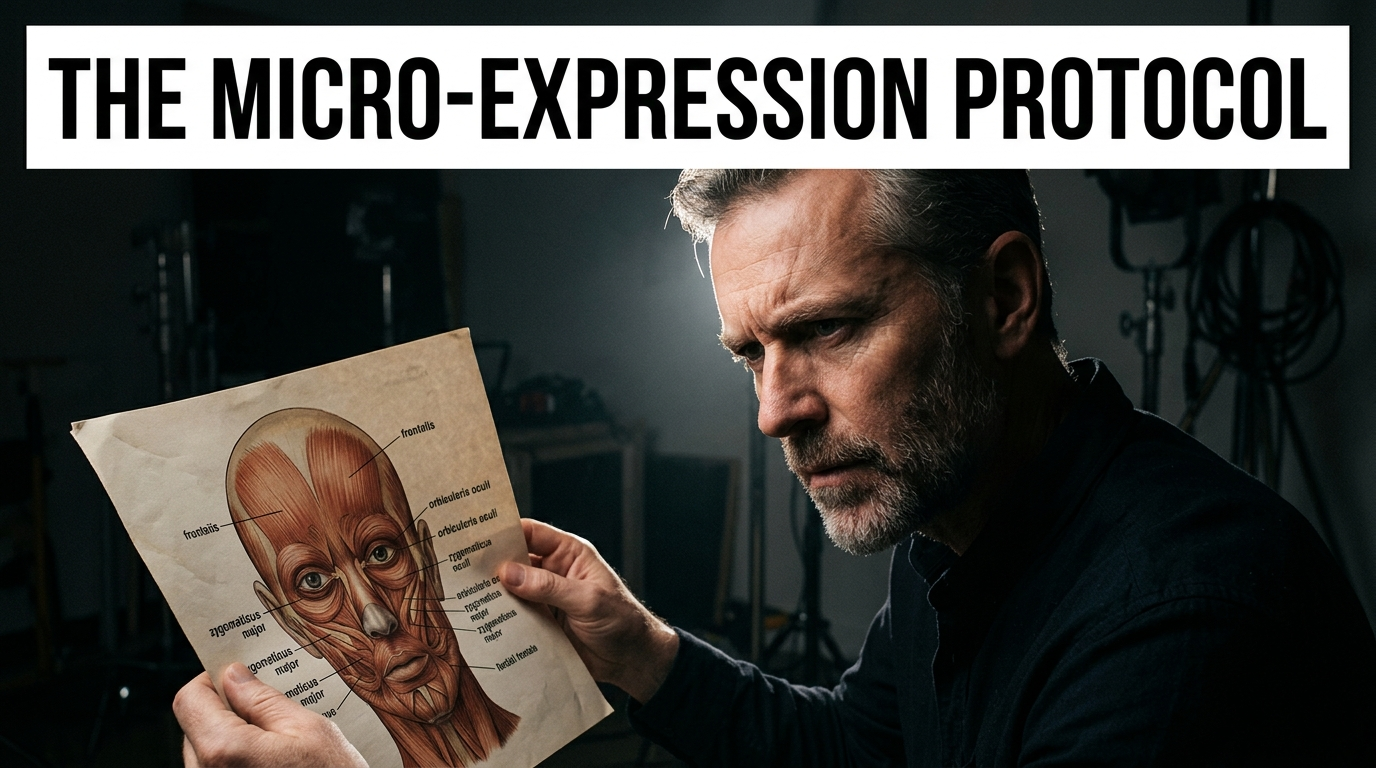
The Plastic Face Problem
The current generation of synthetic humans has solved many superficial problems. Skin texture is cleaner. Hair rendering is more convincing. Lighting can feel expensive. Camera movement can mimic the grammar of prestige cinema. Yet the core failure remains immediately visible to any serious director: the face is technically impressive, but emotionally vacant. The image is polished, but the person does not seem fully alive.
This is the real Uncanny Valley of 2026 generative video. It is not primarily a problem of resolution. It is not a problem of detail, sharpness, or even realism in the conventional sense. The greatest failure is emotional deadness. The audience detects it in less than a second. The eyes drift without intention. The cheeks move with the wrong rhythm. The mouth performs a symbolic version of feeling rather than a human one. The face appears to be announcing an emotion instead of inhabiting it.
That distinction matters. Human beings do not read emotion as a label. They read it as a coordinated event across muscle tension, gaze behavior, blink rhythm, breathing pattern, and posture. When those elements do not align, the viewer experiences the performance as false, even if the skin pores and lighting ratio are excellent. This is why so much AI video still looks expensive and lifeless at the same time. The rendering has improved faster than the performance logic.
The Fallacy of Emotion Prompting
Most beginners make the same mistake. They prompt for emotional nouns and adjectives. They type phrases like "a sad man," "a joyful woman," "an angry executive," or "a grieving mother." This almost always produces weak results because the model does not understand emotion the way a director or actor does. It does not feel sadness. It does not understand grief as an internal state with physical consequences. It predicts visual patterns associated with the word.
That prediction process pushes the model toward statistical averages. "Sad" becomes stock photography sadness: a lowered head, a dramatic tear, a heavy frown, a performance that looks prepackaged and generic. "Happy" becomes even worse: a rigid smile stretched too evenly across the face, bright eyes with no corresponding muscle behavior, an expression that resembles customer service theater more than authentic joy. The machine is not acting. It is assembling a visual shorthand. What it generates is not emotion, but an icon of emotion.
This is the central fallacy of emotion prompting. Directors assume that naming a feeling will produce a performance. In reality, naming a feeling usually produces a caricature. The more abstract the instruction, the more synthetic the result. The model fills in the gap with cliché.
The Biometric Approach
A professional operator takes the opposite approach. The correct method is biometric, not poetic. You do not direct feelings. You direct anatomy. If the goal is grief, you do not ask for grief. You define the visible mechanics that grief creates in the human body. You specify a downward gaze, reduced eye contact, slight tension in the jaw, parted lips, shallow breathing, slowed blink rate, and a mild loss of facial symmetry. If the goal is restrained anger, you do not write "furious." You write: fixed stare, compressed lips, tight masseter muscles, nostril tension, still head position, minimal blink, controlled breath. The performance emerges from physical signals, not emotional vocabulary.
This is the foundation of the Micro-Expression Protocol. Emotion in AI video must be engineered through observable biometrics. The director has to think like a casting director, a portrait photographer, and an anatomy teacher at the same time. What is the eye line doing. Is the orbicularis oculi engaged or not. Is the brow lowering in a symmetrical or asymmetrical way. Is the jaw releasing or bracing. Are the lips pressed, parted, or trembling. Is the breath visible in the upper chest, the shoulders, or not at all. These are not decorative details. They are the performance.
This approach also forces a higher level of discipline. If the face is carrying the emotional scene, the prompt cannot be vague. "Upset" is vague. "Lowered gaze with moist lower eyelids, slight jaw tremor, and restrained lip tension" is usable. "Determined" is vague. "Eyes fixed on a target, chin steady, reduced blink rate, and mild tension in the lower face" is directable. The model responds better when the operator provides concrete anatomical events rather than narrative sentiment.
The Role of Restraint
Restraint is equally important. In fact, it is where most AI performances collapse. Generative systems are naturally prone to over-animation. They want to demonstrate life by adding movement. They will over-smile, over-blink, over-tilt the head, over-shift the mouth, and over-correct the face in ways that feel eager rather than believable. The result is a synthetic performance that looks like it is trying too hard to be human.
A serious director must explicitly suppress that tendency. The prompt should include language such as minimal facial movement, restrained performance, subtle micro-expressions, controlled posture, and no exaggerated emotional display. This is not a minor stylistic preference. It is the difference between prestige drama and plastic melodrama. Real emotion is often most visible in what the face is trying not to reveal. The strongest performance may be a nearly still face with only a slight change in blink rhythm and a faint tightening around the mouth.
Stillness creates cinematic authority because it gives the viewer something to interpret. Over-animation destroys mystery. It answers the emotional question too loudly and too quickly. A believable synthetic human should feel internally active but externally economical.
The Eyes as the Anchor
The eyes are the anchor of this entire system. A synthetic face dies the moment the eyes lose purpose. Human audiences are exceptionally sensitive to gaze behavior. We notice instantly when the eyes are unfocused, floating, or disconnected from the emotional scene. Dead-looking AI is often not dead because of the mouth or skin. It is dead because the eyes are not attached to a real point in space.
This is why eye-tracking must be directed with precision. The operator should state exactly where the subject is looking: eyes locked on the camera lens, eyes fixed on an off-screen person to the left, gaze lowered to the table edge, eyes tracking a moving object in the hallway, brief glance downward before returning to the horizon line. These are not secondary notes. They are structural instructions. Gaze defines thought. If the eyes have no target, the character appears hollow.
Directing authentic AI performance is not ultimately about software literacy. It is about human literacy. The operator who succeeds is usually the one who has studied faces, observed hesitation, understood restraint, and learned how real feeling alters the mechanics of the body. The tool may be artificial, but the craft required to guide it is profoundly human. The future of believable synthetic performance will not be won by people who write more emotional adjectives. It will be won by directors who understand that emotion is visible only when anatomy tells the truth.