The Failure of Language
The central weakness of generative video is not visual quality. It is command fidelity. A text prompt can suggest mood, subject, and broad action, but it cannot function as a camera department. Commercial direction depends on precise spatial decisions: where the actor stands in relation to the product, how near the lens sits to the face, how fast the dolly moves, where the focus falls, and what practical light motivates the scene.
Unreal Engine's cinematic toolset exists precisely because those decisions are discrete and controllable. Epic's documentation for the Cine Camera Actor describes explicit filmback, lens, focus, and crop settings, while Sequencer is positioned as a real-time, multi-track editor for cinematic sequences. Those are measurable parameters, not poetic suggestions. A written prompt, on its own, is a weak substitute for that level of authorship.
That gap is visible across the text-to-video category. Research on controllable video generation repeatedly reaches the same conclusion: text alone is too ambiguous to express fine-grained requirements. Text and image inputs lack precise control over content and motion, and video models have historically overlooked precise camera pose control. For a commercial team, that is not an academic inconvenience. It is the difference between a usable shot and an expensive experiment.
The Directorial Deficit
This is where the slot machine effect appears. The operator pulls the lever with a prompt variation, waits for a result, rejects the framing, rewrites the text, and repeats. The problem is structural. Diffusion systems operate on probability distributions, not on a director's floor plan. They are excellent at inventing plausible pixels, but they do not naturally think in blocking, marks, lens packages, or repeatable camera paths.
Even when the output looks cinematic, the scene often contains hidden instability: eye lines drift, actor spacing shifts, lens logic collapses, or the camera move feels statistically plausible rather than intentionally designed.
That instability is why advanced control frameworks keep moving away from language-only interfaces. The pattern is clear: the closer a production gets to real approvals and real revision cycles, the more it demands hard control signals rather than expressive prose.
The 3D Skeleton
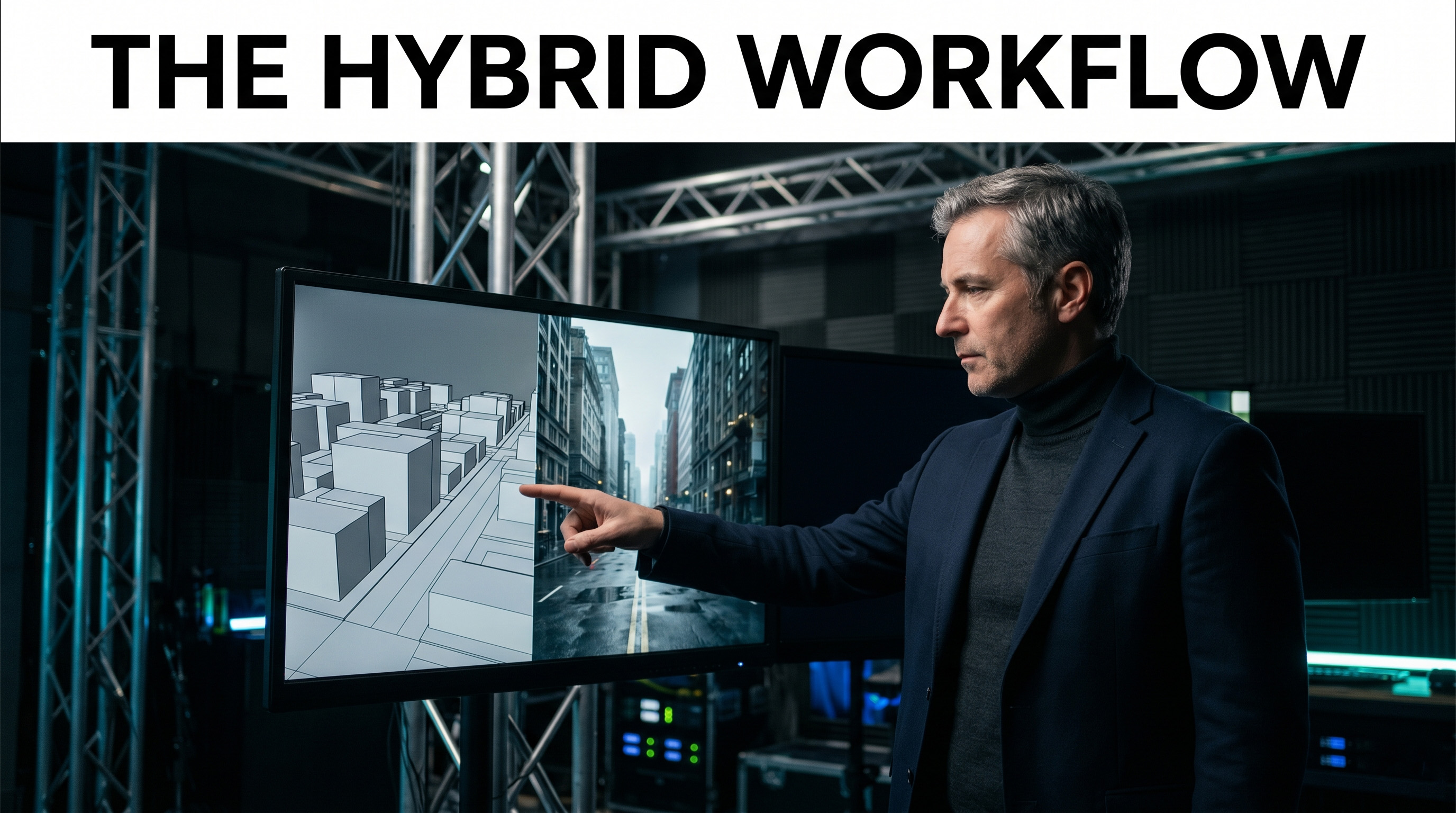
The hybrid workflow solves this by separating structure from surface. Instead of asking text to invent the entire scene, the studio first builds a simple three-dimensional blockout in a real-time engine. This is not a final asset build. It is a grey-box.
In practice, that means a team can stand up a crude set, define actor positions, establish scale, choose a virtual lens, and animate an exact camera move with mathematical repeatability. The result may look ugly, but ugliness is irrelevant at this stage. The objective is structural truth.
That structural pass changes the economics of direction. A creative director can review blocking before anyone cares about texture. A producer can approve shot count and camera language before rendering costs escalate. A CMO can understand geography, pacing, and product framing without getting distracted by unfinished beauty. Most importantly, the team gains a stable source video that already contains the correct spatial relationships. Camera height is locked. Travel distance is locked. Lens behavior is intentional. Lighting direction can be roughed in with enough clarity to become a reliable guide.
The AI Skin
Once the three-dimensional skeleton exists, the AI model can finally be used where it is strongest: converting structural input into high-value imagery. This is where video-to-video systems and structural conditioning methods become commercially meaningful. The model is no longer being asked to invent framing from scratch. It is being asked to transform a controlled motion plate into finished visual language.
The crude render becomes an inescapable map, and the model's job is to skin that map with realism. This is the correct division of labor. The real-time 3D engine handles camera logic, spatial continuity, and lighting architecture. The AI handles texture richness, atmospheric response, surface detail, cloth behavior, skin finish, and stylistic lift. In production terms, the machine stops improvising the skeleton and starts decorating it. That shift turns AI from an unreliable director into a highly capable rendering layer.
The Death of the Prompt Artist
This is why the future of commercial AI production will not be owned by the pure prompt artist. Typing clever adjectives into a text box is not enough when a campaign requires shot matching, legal review, product accuracy, and revision discipline. The market is moving toward teams that understand virtual production grammar: layout, previs, lensing, blocking, timing, and camera motion. AI still matters, but as the final rendering skin, not as the sole author of physical reality.
The winners in this market will be the studios that treat generative models as one layer in a larger pipeline. They will build scenes in real-time 3D, approve geometry before style, and use conditioned video generation to translate rough structure into finished frames. That workflow does not make the process less cinematic. It makes it more directable. And for brands spending serious money, directability is the difference between synthetic novelty and actual production control.