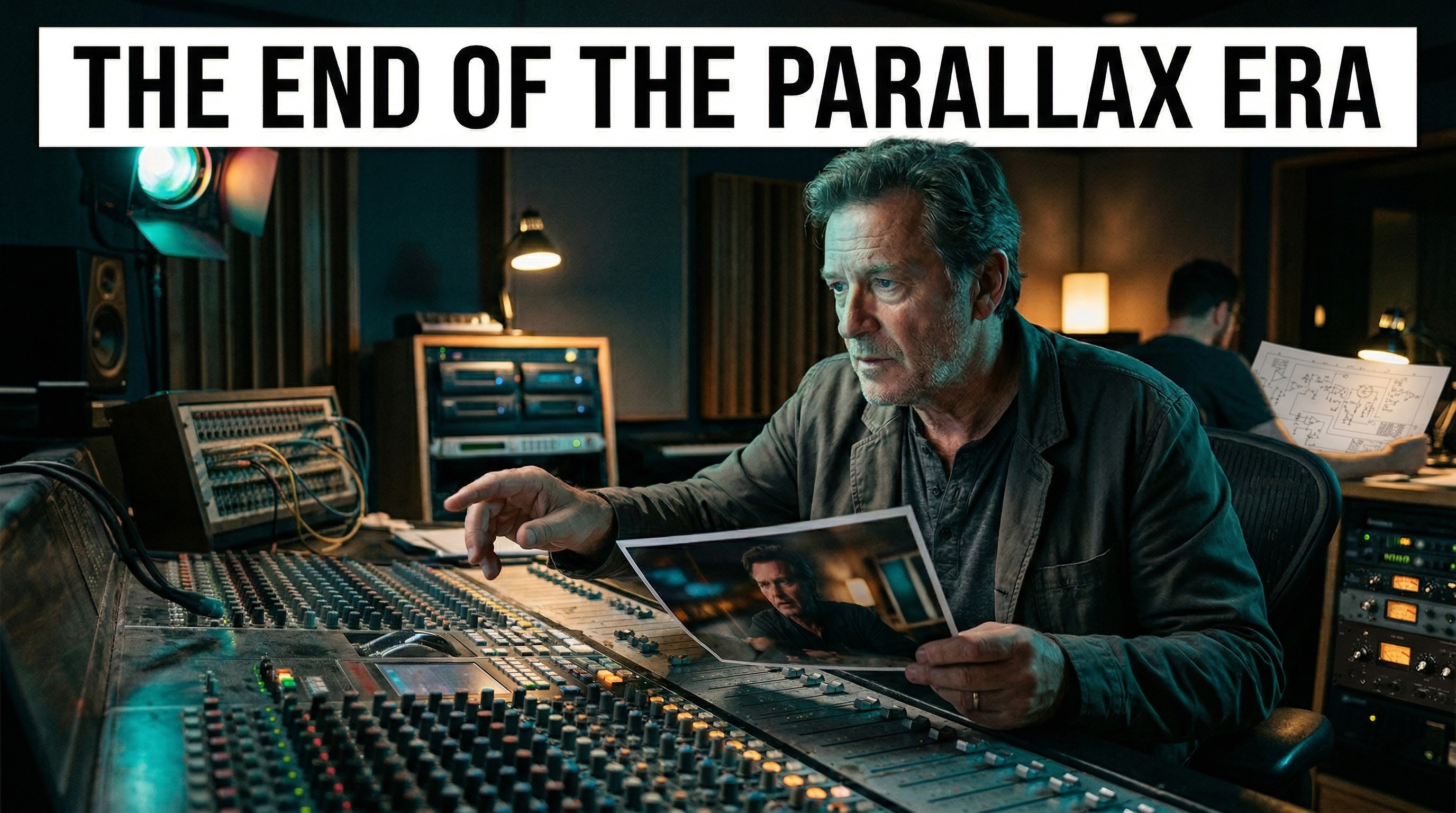
The Illusion of Novelty
There was a not very distant phase in generative media when image-to-video meant one thing: a cheap illusion. You took a still photograph, fed it into a tool, and watched the software fake a little depth. The foreground slid one direction, the background drifted another, and suddenly people called it cinematic. Water rippled. Smoke twitched. Hair floated. A static portrait got a hollow push in that looked impressive for three seconds on a social feed and embarrassing on a proper screen.
That phase had one job: novelty.
It was the era of displacement maps, shallow depth cheats, and synthetic parallax passes pretending to be motion design. Most of it was not direction. It was decoration. It gave marketing teams a way to make archive stills feel a little less dead, and it gave platforms one more engagement trick to serve into the algorithm. For lightweight social content, that was enough. But the moment anyone tried to demand real camera movement, real character action, or real scene logic, the illusion collapsed. Faces warped. Arms fused into wardrobes. Backgrounds tore open. Architecture bent like wax. The image did not evolve, it melted.
That was the tell.
Early image-to-video systems were not truly reasoning about a scene. They were warping pixels and guessing where the gaps should go. They could imply motion, but they could not sustain it. They were performing a visual trick on a flat surface. Useful in a pinch, amusing at first glance, but fundamentally fragile. The tool had no stable internal understanding of what the image contained. It knew color and edge relationships. It did not know the room.
Inferring Structure
That is what has changed.
Modern image-to-video engines are no longer acting like filter packs. The serious systems are doing something far more important: they are inferring structure. They analyze the scene for geometry, depth, occlusion, texture, lighting relationships, and physical continuity. They are not simply stretching the source image forward. They are projecting a three-dimensional interpretation of that image through time. The machine is attempting to understand the world implied by the frame, not just animate the frame itself.
That distinction separates novelty from production.
When a modern engine performs well, it is not adding wiggle to a still. It is building a provisional simulation. It understands that the subject has volume, that the background continues behind the shoulder, that the window is a light source, that the jacket folds with gravity, and that a camera move changes spatial relationships rather than just magnifying the center of the image. In other words, it is no longer faking movement on top of a photograph. It is reconstructing a scene and then directing that scene through synthetic cinematography.
The B2B Reference Anchor
For serious studios, that changes the entire meaning of the input image.
The input image is no longer just a first frame. It is a visual anchor.
That is the B2B reality most casual commentary misses. Brand work does not live or die on whether a tool can create a flashy motion test. It lives or dies on compliance, continuity, and control. A CMO does not care that the lake in the background can shimmer. They care that the hero wardrobe remains on brand, that the skin tones remain consistent with the campaign look, that the product label does not drift into a new palette, and that the lighting mood matches the approved creative direction across every asset in the campaign.
Text prompts are too soft for that job.
Text is interpretive. Text is slippery. Text is a negotiation with the model. You can describe a specific wardrobe, a specific amber practical glow, a specific contrast ratio, a specific cold urban dusk, and the engine will still improvise. Sometimes it improvises beautifully. Sometimes it wanders off the brand brief and hands you something aesthetically pleasing but strategically useless. For consumer play, that unpredictability is part of the fun. For commercial production, it is a liability.
A reference image solves that problem because it behaves like a contract.
It tells the engine, this is the face, this is the costume, this is the fabric texture, this is the production design, this is the color discipline, this is the lensing mood, this is the shadow pattern, this is the emotional temperature of the frame. The studio is no longer asking politely through text. It is supplying evidence. That image becomes the master style guide for the shot. It locks the system into a narrower range of acceptable outcomes.
The Director's Intent
That is why image-to-video grew up.
The real value is not that it can animate stills. The real value is that it can hold a line.
A serious studio can now use a reference still to stabilize character identity, preserve wardrobe continuity, maintain lighting logic, and protect art direction while generating forward motion inside the shot. That means a single hero frame can become the control center for an entire sequence. The image anchors the engine. The prompts shape the behavior. The camera instructions guide the energy. The output starts to behave less like a visual accident and more like directed simulation.
That does not reduce the need for skill. It increases it.
Anyone can click a button and make a static image wobble. That takes no eye and no discipline. But directing a generative engine from a reference anchor is a completely different craft. You need to understand why the source frame works in the first place. You need to see the lighting falloff across the cheekbone and know how much motion the image can tolerate before the illusion breaks. You need to understand compositing logic, lens psychology, blocking, negative space, depth of field, and editorial timing. You need to know whether the camera should push, drift, orbit, or hold, and more importantly, why.
This is where many teams still get exposed.
They think the model has become the director. It has not. The model has become more sensitive to direction, which is not the same thing. A strong reference image in weak hands still produces ornamental sludge. A strong reference image in experienced hands becomes a shot plan. The operator decides how much environmental motion to introduce, how much character movement the scene can support, where the viewer attention should land, and when the camera should intensify versus when it should observe. Those are directing decisions, not prompt tricks.
Authored Simulation
And that is the larger lesson for brands.
The novelty phase is over. The question is no longer whether AI can make a photo move. The question is whether your studio knows how to turn a single approved image into a controllable cinematic world. That is a much higher bar, and it should be. Because clients are no longer buying curiosity. They are buying precision.
The old parallax era was about pixel warping. This era is about authored simulation.
We are not making still images wiggle anymore. We are taking a single visual anchor and using it to build a living world with rules, continuity, and intent. That is not a filter. That is direction.