The Epic Crutch
The generative video industry has a favorite hiding place: the dramatic montage. Slow camera drift, moody silhouettes, glowing particles, heroic pacing, and a face turned thoughtfully toward the horizon have become the visual comfort food of synthetic media.
The reason is not mysterious. These sequences are easy for models to produce because they align perfectly with the system's underlying instincts. Generative engines like smooth transitions, atmospheric lighting, shallow emotional cues, and broad cinematic gestures. They are statistically rewarded for coherence, polish, and visual harmony. The result is a flood of content that looks impressive for two seconds and then dissolves into sameness.
This is the epic crutch. It is not always bad work, but it is often structurally lazy. It allows the system to operate in its preferred mode, which is beauty without tension. For commercial storytelling, especially in short-form channels, that default is increasingly a problem. A brand does not win attention by producing the hundredth slow-motion visual poem about ambition. It wins by creating friction, surprise, and a reaction strong enough to interrupt a thumb in motion. That requirement changes the production challenge entirely. It moves the brief away from "make it cinematic" and toward a far harder goal: make it funny.
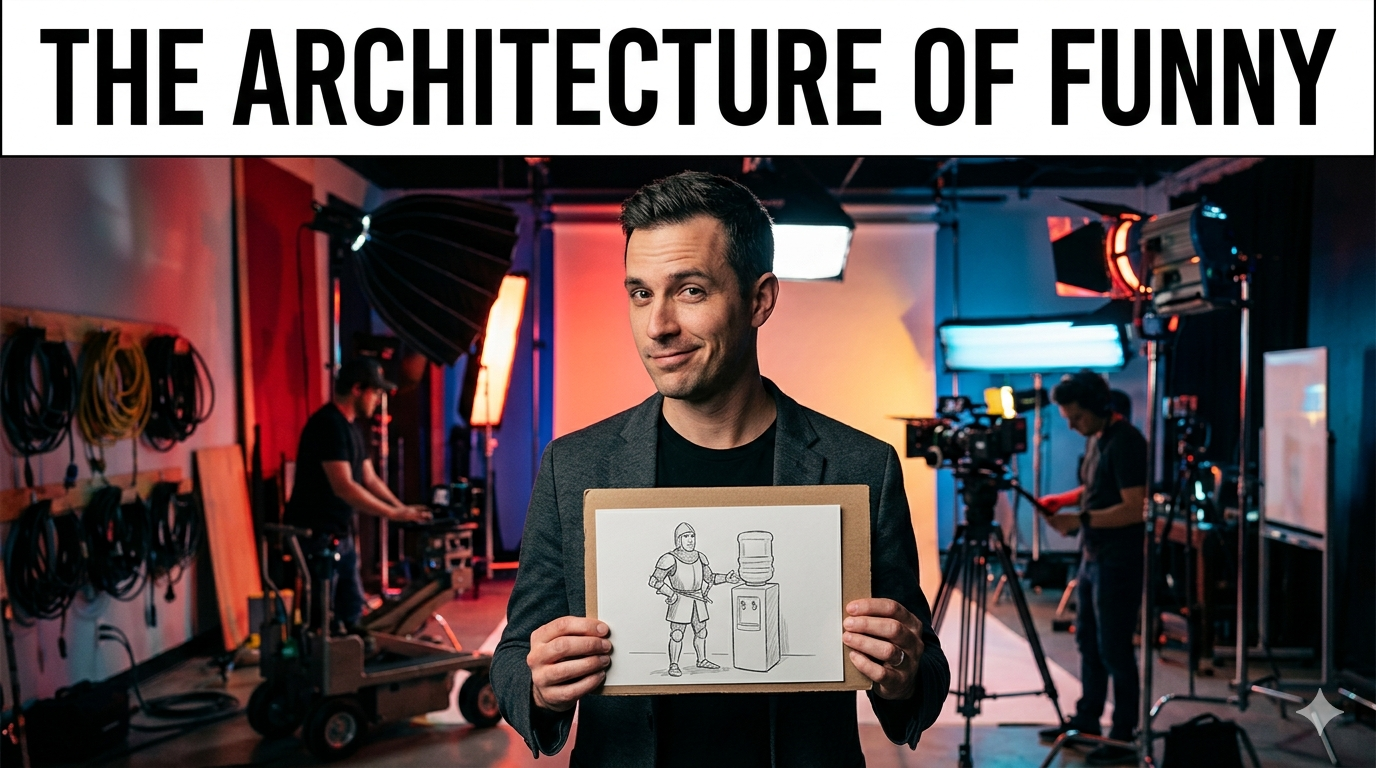
The Architecture of Funny
Comedy is not just another genre. It is a hostile environment for synthetic video. Drama can survive vagueness. Comedy cannot. A dramatic clip can still function if the expression is slightly off, if the pacing drifts, or if the action lands one beat late. In fact, many dramatic ads hide their structural weakness inside music, color, and scale.
Comedy offers no such mercy. A joke either lands or it does not. The frame either creates tension or it does not. The expression is either awkward in the right way or it slips into plastic neutrality. Humor exposes every weakness in an AI pipeline because humor depends on the exact things generative models usually try to smooth away.
That is the architecture of funny: visual friction. Humor often comes from a controlled violation of expectation. A serious man delivering nonsense with perfect confidence. A medieval knight ordering office supplies. A luxury product treated with ridiculous emotional gravity. A face that holds irritation for half a second too long. A character who realizes a social disaster one frame before the audience does. These are not broad cinematic moods. They are anomalies. They rely on contradiction, discomfort, asymmetry, and specific behavioral detail. They require the image to contain something slightly wrong, but wrong with precision.
That is exactly where generative systems become unreliable. Their job is to collapse chaos into plausibility. They are constantly trying to remove strange edges, normalize anatomy, smooth transitions, and average away the unusual. Comedy asks them to do the opposite. It asks them to preserve the bizarre, hold the awkward pause, and commit to an absurd visual idea without accidentally making it elegant. This is why so much AI comedy feels accidentally strange rather than deliberately funny. The system can create surrealism by mistake. That is not the same as constructing a joke.
The Three-Second Hook
This challenge becomes even more severe on short-form platforms. TikTok, Reels, and Shorts are not environments where atmosphere gets thirty seconds to bloom. They are reflex arenas. The viewer is not patiently evaluating visual craft. The viewer is deciding, almost instantly, whether something deserves attention. That means the opening moment has to create immediate cognitive tension. It has to signal, within the first beat, that the next few seconds contain a reward worth staying for. Comedy is uniquely suited to this task because absurd contrast is one of the fastest ways to break passive scrolling.
A dramatic ad usually asks for emotional investment before delivering its payoff. Short-form audiences rarely grant that courtesy. Comedy can bypass the negotiation. A bizarre image, a social misfire, or a sharply recognizable human annoyance can trigger curiosity before the rational mind has time to dismiss it. That is why the three-second hook matters so much. The first image cannot simply be beautiful. It must be unstable in an intentional way. It must contain a tiny crisis. A costume in the wrong context. A facial expression that suggests imminent embarrassment. A visual setup that promises collision. Scroll-stopping content is not built from polish alone. It is built from tension.
The Timing Deficit
Then comes the most technical problem of all: timing. Comedy does not live in the prompt. It lives in the cut. A joke can die from half a second of delay. A reaction shot can fail because it arrives one beat too early. A physical gag can collapse if the viewer sees too much setup or not enough aftermath.
This is where most casual AI workflows break down. Generative systems are not natural comedians because they do not think in edit points. They think in continuous visual plausibility. They are trying to produce a seamless clip. Comedy often requires interruption, escalation, and precisely measured release.
Professional teams solve this with structure, not hope. They do not ask the model to create a perfect joke in one pass. They design the joke as a sequence architecture. Setup frame. Escalation frame. Reaction frame. They isolate the visual beats, control shot duration, and treat the generated footage as raw material for rhythmic assembly. In other words, comedy requires a pipeline that behaves less like a magic box and more like a disciplined editorial machine. The funniest AI short-form work is usually not the most visually elaborate. It is the most tightly controlled.
Conclusion
That control extends to performance direction as well. Comedy is often hidden inside micro-expression, not spectacle. The slight eye shift, the delayed blink, the jaw tension of social regret, these details are small, but commercially powerful because they feel recognizably human. Short-form audiences respond to emotional precision faster than they respond to cinematic grandeur. A beautiful synthetic sunset may earn polite admiration. A perfectly timed look of silent annoyance earns a share.
This is why comedy is the real benchmark for AI video maturity. Anyone can generate attractive imagery. Many can produce something that feels expensive. Very few can produce a genuine laugh while protecting brand quality, maintaining pacing discipline, and preserving enough human specificity to feel intentional rather than random. That is the difference between visual decoration and directorial control.
The future of commercial short-form does not belong to teams who merely know how to make AI look beautiful. It belongs to teams who understand that beauty is the easy part. The real frontier is friction. The real test is timing. The real victory is not a cinematic sunset, but a perfectly engineered punchline that lands before the viewer can scroll away.