The Graveyard of Pretty Videos
There is a mass grave beneath every social media feed. It is filled with gorgeous, lovingly crafted video content that no one watched. Cinematic color grades. Sweeping drone shots over golden hour landscapes. Slow reveals of products glistening on marble countertops. All of it: dead on arrival. Scrolled past in a fraction of a second by a thumb that felt nothing.
The cruelest irony of modern advertising is that aesthetic quality has almost no reliable correlation with performance. The most beautiful video your team has ever produced can generate fewer conversions than a shaky, unpolished clip shot on a phone in a parking lot. This is not a failure of craft. It is a failure of strategic sequencing. You placed the beauty before the hook, and weak opening signals likely reduced the chances of the platform pushing your asset any further. Meta's own internal best practices research confirms this pattern: ads that fail to establish relevance in the first moments see steep drops in delivery efficiency (1).
Social feeds are not galleries. They are not theaters. They are rivers of content moving at the speed of boredom, and every frame you produce is competing with a baby laughing, a building collapsing, a celebrity saying something absurd, and fourteen other ads that already figured out what you didn't. The feed does not care about your production budget. It cares about one thing: whether the next piece of content is more interesting than yours.
The Psychology of the Scroll
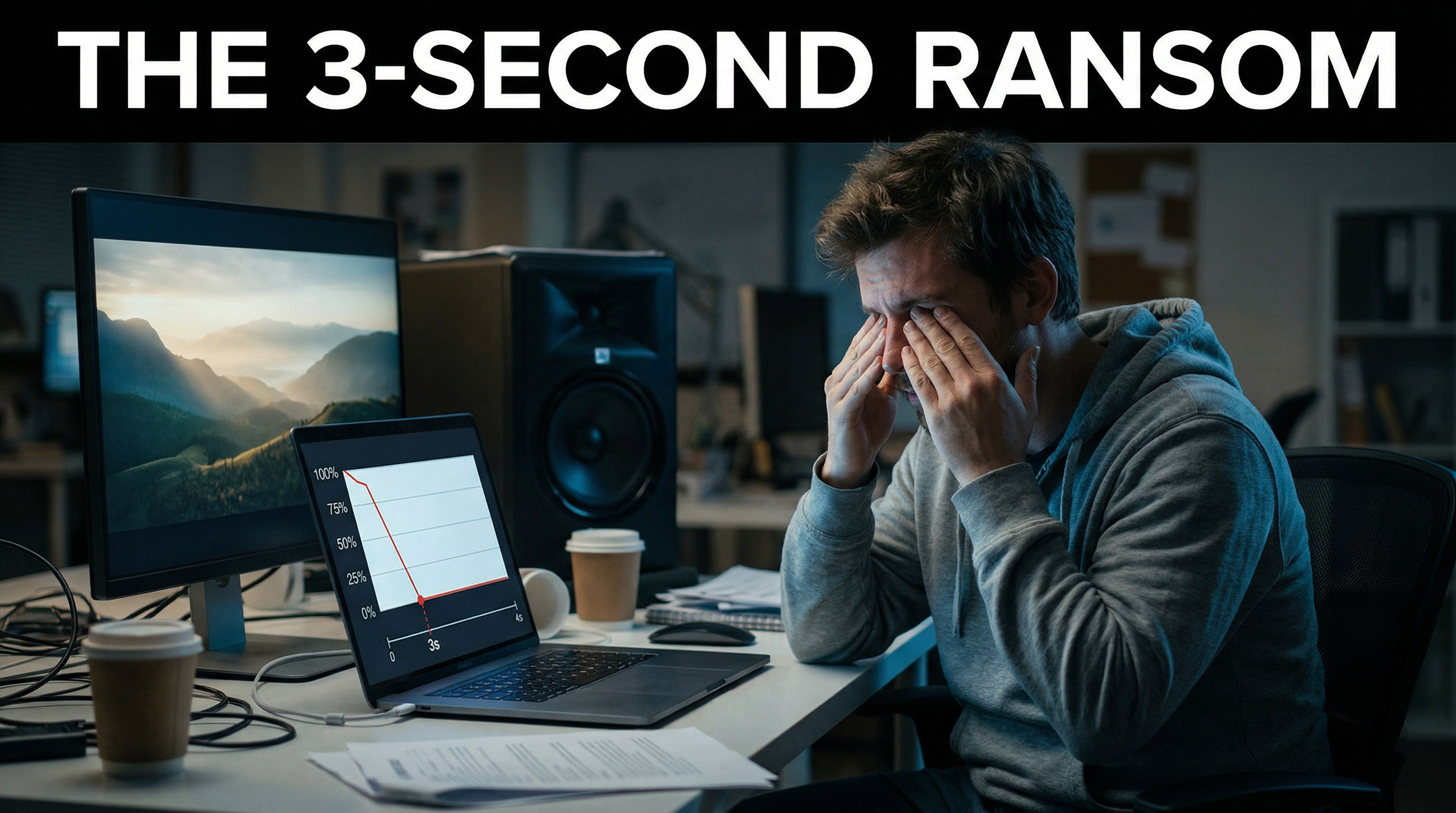
Let's talk about the ransom. You have roughly three seconds. Some platforms give you less. In that window, the viewer's brain is making a binary decision at a nearly subconscious level: stop or continue. This is not an intellectual evaluation. Research on rapid visual attention suggests that our perceptual systems are highly sensitive to novelty, incongruity, and emotional charge, responding to these signals far faster than conscious reasoning can engage (2). If your opening frames register as predictable, the thumb keeps moving, and everything you built after second four likely ceases to exist for that viewer.
Platform analytics support this with uncomfortable clarity. Many retention curves on branded video content show something closer to a cliff than a gradual slope. In a significant number of cases, the audience does not slowly lose interest. They never developed it. The drop frequently happens before the logo appears, before the voiceover begins, before the product enters the frame. Facebook's published guidelines on video creative explicitly recommend front loading the brand message and the hook within the first three seconds precisely because of this observed behavior (3).
Three seconds is not a guideline. It is a ransom note. Pay it or disappear.
The AI Default Problem
Now layer generative AI into this equation, and the problem compounds. In practice, the major video generation models currently available (Sora, Runway, Kling, and their emerging competitors) tend to share a common aesthetic bias. These systems were trained heavily on cinematic footage, stock libraries, and film. They consistently default toward slow, ambient, contemplative motion. A prompt like "luxury skincare product on a table" will reliably produce a languorous, softly lit tracking shot that looks like it belongs in a Terrence Malick film.
That output is beautiful. It is also, in most social media advertising contexts, performance poison.
The machine does not understand the economics of attention. It has no concept of a scroll. Its training optimizes for what looks like cinema, and cinema assumes a captive audience seated in a dark room with nowhere else to go. Social media is the opposite environment: a distracted viewer with infinite alternatives one millimeter away under their thumb.
Letting the AI dictate pacing is one of the most common and most costly mistakes a director can make in this context. Not because the tool is bad, but because its instincts are calibrated for the wrong delivery environment. Slow motion is earned real estate in advertising. You cannot open with it. You have to survive the first three seconds before you have permission to be contemplative.
Architecting the Hook
So how do professionals solve this? They engineer the first three seconds with the same precision a surgeon uses on an incision. Every frame is intentional. Every choice is strategic.
Extreme close ups are one of the most reliable weapons. A macro shot of texture, skin, liquid, or mechanical motion at an uncomfortable scale creates instant visual novelty. The brain struggles to immediately categorize what it is seeing, and that microsecond of uncertainty is often enough to pause the scroll. Research on attentional capture confirms that stimuli which are difficult to categorize tend to hold gaze longer than those instantly recognized (4).
Breaking the fourth wall works because direct eye contact tends to trigger a social response that is very difficult to ignore. A face looking straight into the camera, especially mid action or mid sentence, activates social processing in ways that can override the impulse to scroll.
Abrupt audio cues exploit the fact that many users scroll with sound on (or at minimum, respond to sudden audio shifts when autoplay activates). A snap, a voice cutting in at full volume, a moment of jarring silence after noise: these function as pattern interrupts that capture attention before deliberate evaluation kicks in.
Visual dissonance is the most advanced technique. Place something in frame zero that does not belong. A product in an absurd context. A color that violates the palette of the surrounding feed. A motion that contradicts expected physics. Dissonance creates a cognitive gap, and the brain's tendency is to stay and resolve it (5).
None of these techniques require abandoning quality. They require reordering priorities. The hook is not decoration. It is structural. It is the load bearing wall of the entire piece. Build it first, then layer beauty on top.
When working with generative AI, this means prompting with surgical specificity. Do not ask for "a cinematic product reveal." Ask for "an extreme macro shot of condensation sliding off a cold surface, camera pulling back rapidly to reveal the product in an unexpected environment." Force the model out of its ambient comfort zone. Override its default pacing. Treat the AI as a renderer, not a director. The creative strategy must come from a human brain that understands what a timeline does to passive content.
Beauty Is a Luxury You Earn
The hard truth of this craft is that beauty without a hook is self indulgence. It is a director making something for their reel, not for the client's results. Audiences will absolutely appreciate gorgeous visual narrative, exquisite motion design, and cinematic color work. But only after you have earned their attention in the opening seconds.
Beauty is not the price of admission. It is the reward you offer after the door is already open. The ransom comes first. Every time. Pay it with shock, with dissonance, with something the thumb cannot ignore. Then, and only then, do you have permission to be beautiful.
References
- Meta for Business, "Best Practices for Video Ads," Meta Business Help Center, 2023.
- Öhman, A., Flykt, A., & Esteves, F., "Emotion Drives Attention: Detecting the Snake in the Grass," Journal of Experimental Psychology: General, 130(3), 2001.
- Facebook Blueprint, "Creative Best Practices: Capture Attention Quickly," Meta, 2022.
- Berlyne, D. E., "Novelty, Complexity, and Hedonic Value," Perception & Psychophysics, 8(5), 1970.
- Loewenstein, G., "The Psychology of Curiosity: A Review and Reinterpretation," Psychological Bulletin, 116(1), 1994.