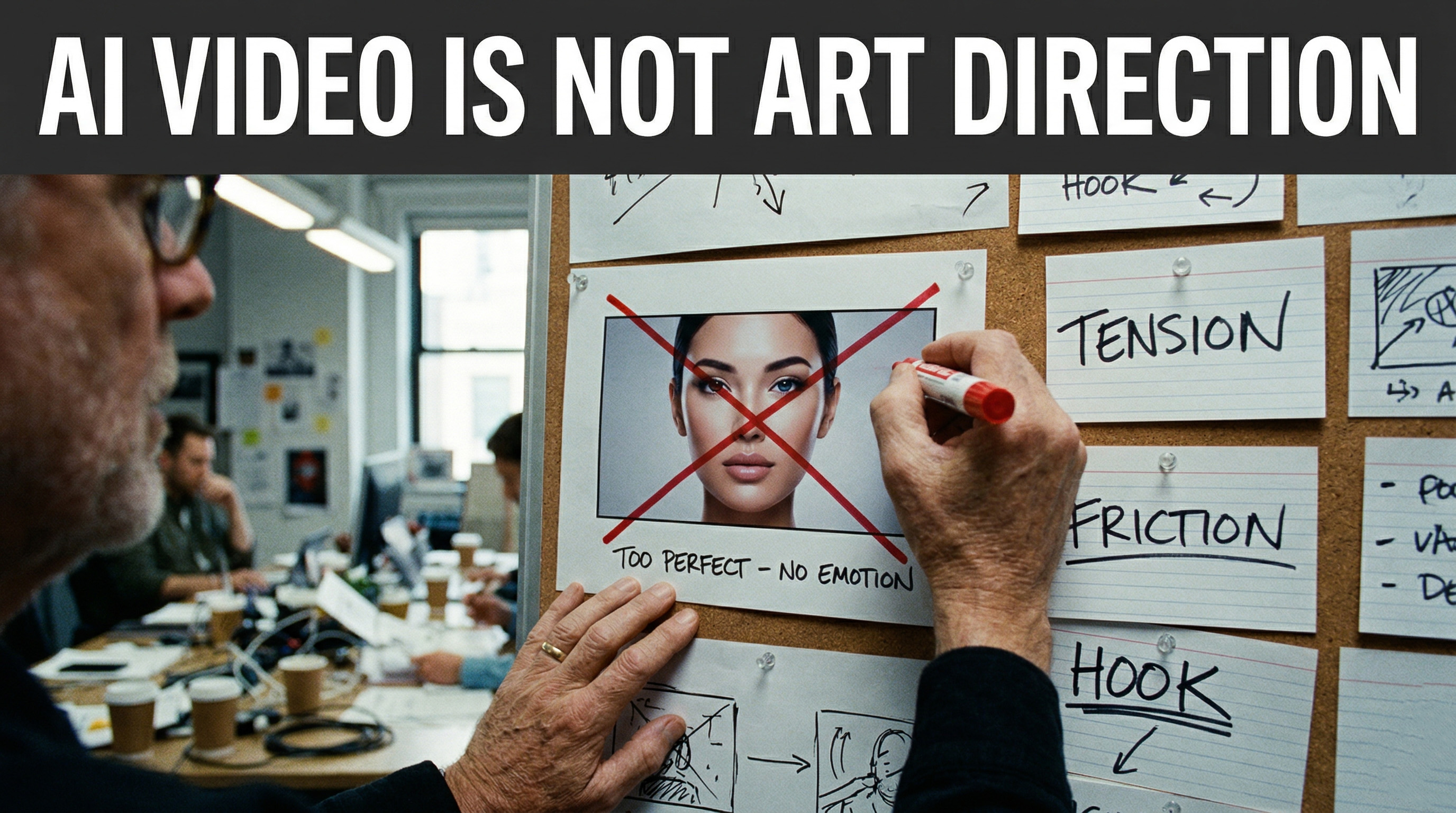
The market is drunk on a fantasy. A founder opens a premium AI video model, types a few cinematic adjectives, gets back a glossy sequence, and suddenly believes the gap between an amateur and a commercial director has collapsed. It has not. Access to a powerful image generator does not create judgment, taste, strategic discipline, or the ability to shape desire. It creates access. That is all.
We have seen this confusion before. Giving someone an 8K RED camera does not make them capable of building a campaign that moves product. It does not teach them how to pace a reveal, when to deny information, how to frame status, or how to construct tension inside seven seconds of vertical video. It does not tell them what emotion the audience should feel at second one, what belief should shift by second four, or what action should feel inevitable by the end. The camera records. The operator directs. AI is no different, except the misunderstanding is worse because the machine returns something polished enough to flatter bad instincts.
That polish is exactly what makes the illusion dangerous. Poor creative direction used to look obviously poor. Weak lighting, bad framing, awkward blocking, all of it exposed the lack of craft immediately. Generative video hides incompetence behind surface beauty. It gives mediocre operators expensive looking pixels, then invites them to confuse visual novelty with persuasion. A beautiful shot is not an ad. A surreal transition is not a hook. A cinematic face in soft light is not a reason to care.
Commercial advertising has never been a beauty contest. It is applied psychology under brutal time constraints. The job is not to create images that look impressive in isolation. The job is to engineer attention, guide interpretation, and compress brand meaning into a sequence that survives the violence of the feed. That requires decisions most casual users never even consider. What is the first visual promise? What tension is being opened? What insecurity is being activated? What reward is being implied? What status signal is being offered? What friction is being removed? What belief is being challenged? If those questions are not driving the piece, the prompt is not direction. It is decoration.
This is the line between prompt engineering and art direction. Prompt engineering asks, what can the model produce? Art direction asks, what must the audience feel? The amateur chases aesthetic output. The professional chases behavioral effect. One wants a cool image. The other wants a controlled reaction.
That difference changes everything. An amateur prompts for atmosphere, epic lighting, luxury textures, impossible camera movement, dreamlike beauty. The result often looks expensive, but emotionally vague. A professional starts upstream. They identify the brand posture, the market tension, the psychological hook, and the conversion goal. Then they use the model as an execution engine inside those constraints. The prompt is not a wish. It is a control surface.
Consider the difference between asking for a beautiful product shot and directing for desire. The amateur wants shine, slow motion, dramatic reflections, premium music, and a stylish close up. The professional asks whether the product should feel aspirational, trusted, urgent, intimate, or dominant. Those are not visual flavors. They are strategic instructions. A serum sold through authority should not be framed like a fashion fragrance. A B2B service sold through credibility should not be paced like a music video. A wellness brand promising calm should not use aggression just because the model renders intensity well. When people say AI can generate ads, what they often mean is that AI can generate footage. Footage is not strategy, and strategy is where the money is won or lost.
Then there is the default aesthetic, the silent disease of generative commercial work. Most models are deeply comfortable in the same visual register. Glossy skin, immaculate environments, luxurious backlight, shallow depth of field, graceful camera drift, slow motion, emotionally neutral faces pretending to be profound. It is a seductive look because it resembles production value. It also resembles nothing that stops a real audience anymore. The feed is already saturated with polished emptiness. Generic beauty has become camouflage.
Professionals understand that the real skill is not getting the model to look good. It is getting the model to stop looking like itself. That means breaking its habits with intention. You may need harsher contrast, uglier realism, more friction in the composition, stranger timing, less polished motion, messier environments, more truthful faces, or a more aggressive entry point. You may need a shot that feels improperly close, a pacing pattern that creates discomfort, or a product reveal that delays gratification instead of serving it instantly. The point is not to reject beauty. The point is to stop worshipping it.
Advertising that converts is rarely built from generic prettiness. It is built from precision. Precision in rhythm. Precision in tension. Precision in what the audience is allowed to understand and when. Scroll stopping work often feels more directed than generated. It has edges. It has intention. It knows when to be clean and when to be abrasive. It knows when to flirt with aspiration and when to weaponize reality. Those choices do not emerge automatically from the latent space. They are imposed on it.
This is where many agencies will be exposed. The weak ones will use AI as a shortcut for ideas they never had. They will flood clients with variations of the same glossy emptiness and mistake volume for mastery. The strong ones will do the opposite. They will use AI to accelerate testing, expand visual possibility, compress production cycles, and prototype sharper concepts faster than traditional pipelines allow. But the core value will remain exactly where it has always been, in the people who can think clearly about the audience before a single frame is generated.
AI will not kill creative agencies. It will sharpen the divide between operators and directors. Between those who ask the machine for something pretty and those who force it to serve a strategic emotional outcome. The machine can generate pixels at astonishing speed. It cannot generate conviction, restraint, taste, or intent. It cannot decide what the brand should mean in the mind of a stranger. It cannot choose the pressure point that turns passing attention into action.
That work still belongs to professionals. Not because the tool is weak, but because persuasion is harder than rendering. And always will be.