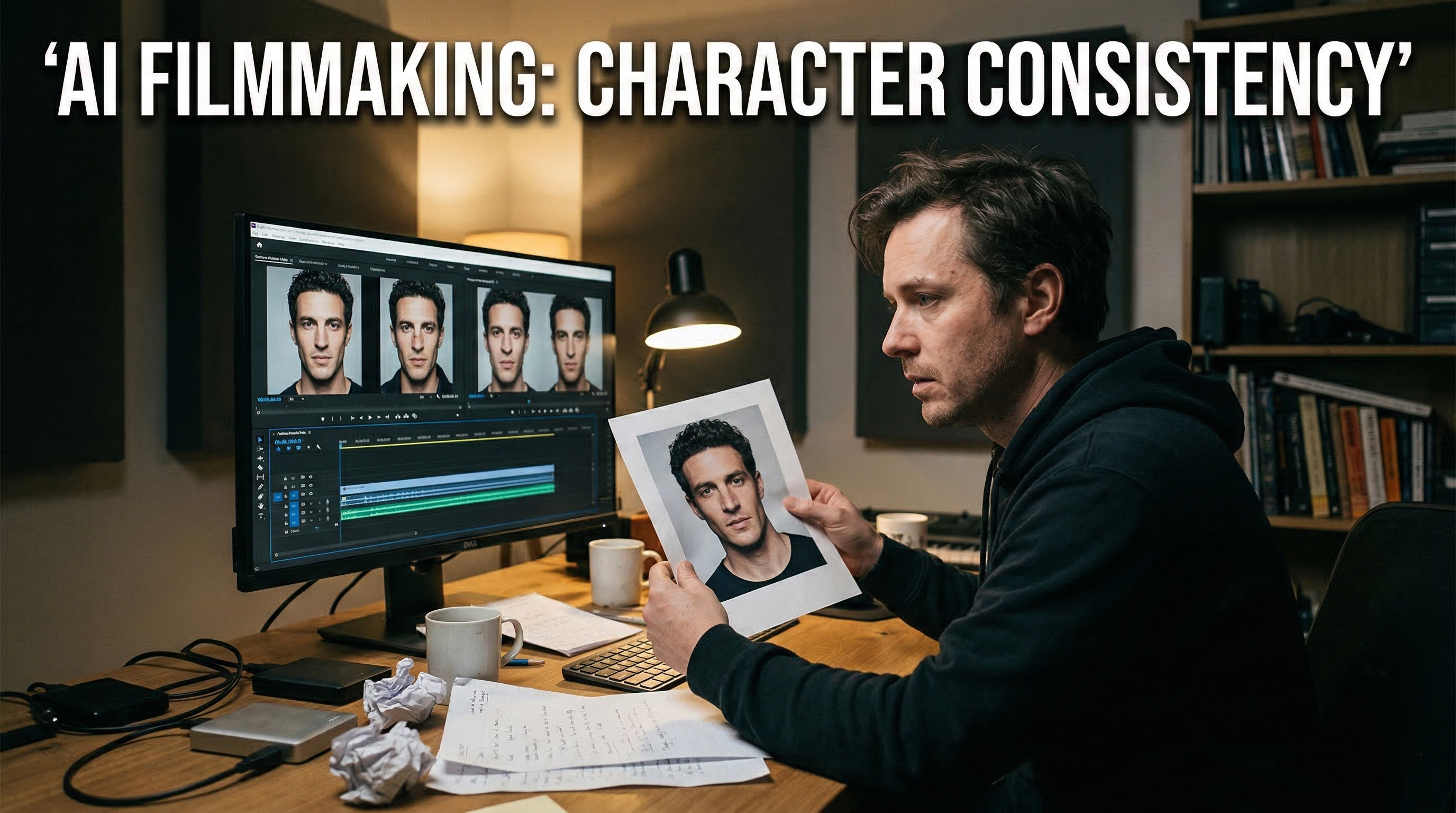
The nightmare is always the same: you get a gorgeous first shot. Your character is perfect. The skin texture, the haircut, the gaze, everything holds up. You generate the next shot, and suddenly, it’s not the same person. The jawline has narrowed, the eyes have drifted, the perceived age has shifted. With every new angle, the hero of your film becomes their own approximate cousin.
If you're working seriously in AI filmmaking, you have to accept a simple truth, forged in the pain of the timeline: character consistency is never given by default. It is built, it is locked down, and when it can't be completely secured, the directing is designed to hide the gaps. Here is the exact workflow to stop suffering from the amnesia of generative models.
Act 1: Why AI Has a Short Memory (And How to Force It to Remember)
Video generators don't "remember" your character like a classic 3D pipeline would. They recalculate a plausible image from a set of constraints. The problem is that visual identity is a bundle of micro-signals (the distance between the eyes, hair volume, skin texture).
As soon as you ask for a new angle, dramatic lighting, or complex action, the model panics. To satisfy the overall composition of the shot, it will sacrifice a bit of your character's identity. On the production of my short film Lily and the Old Man, I almost lost my mind when my lead actor morphed from a weathered homeless man into a pristine catalog model just because I changed the camera axis.
The solution? The master image.
A common mistake is taking any beautiful frame and using it as a reference image. Your master image must be a true casting sheet: a neutral frontal portrait, on a simple background, with soft lighting. An image reference shouldn't be a blurry moodboard, but a strict morphological constraint.
Act 2: Locking It Down With Text (The Prompting Bible)
Vague artistic prompting is the direct enemy of continuity. A prompt like "beautiful woman, cinematic, realistic, dramatic lighting" does not describe a character; it describes a weak intention. The AI will fill the gaps however it pleases.
To keep the same character, you must write as if you are giving a cross-brief to the wardrobe, hair, and makeup departments. Avoid words that leave too much room for interpretation (handsome, striking, expressive). Opt for descriptive, visually measurable anatomy. Here is what a truly locked-down "Identity Block" looks like:
"35-year-old woman, oval face, medium-brown skin, almond-shaped dark brown eyes, straight narrow nose, full lower lip, defined cheekbones, short natural black curly hair, slim build."
For a multi-scene production, I always create a Prompting Bible. This living document contains the master prompt, the wardrobe block, but most importantly, the fixed negative prompts (no bangs, no heavy makeup, no age shift). As soon as multiple shots are strung together, this bible prevents the fatal flaw: rewriting the character from scratch for every generation.
Act 3: The Safety Net (Cheating in the Edit and Staging)
Even with the best pipeline in the world, perfect identity across all shots is a miracle. This is where you must stop being a "prompter" and return to being a director. Editing serves to protect the illusion.
- Design for the AI, not against it: When I know a character will be unstable, I change the staging. No more endless frontal shot/reverse-shots. I use shallow depth of field, over-the-shoulder framing where the face is partially obscured, or chiaroscuro lighting. It's not about hiding the character, but reducing the amount of facial information the AI has to generate perfectly.
- Cuts that save the day: If a character drifts slightly between two shots, the transition can absorb the perceptual shock. Cut on a head movement, a blink, or a physical action. When the viewer's attention is grabbed by the dynamics of the movement, their brain analyzes the exact topology of the jawline much less.
- The power of cutaways (Inserts): Cutaways are your quality assurance. The drift is glaring when you cut from one close-up to another slightly different close-up. Break that direct comparison. Insert a shot of trembling hands, a detail in the set, or the other character's reaction. You create a perceptual micro-break that allows the brain to "glue" the identity back together without blinking.
The Golden Rule
Never ask the AI to "remember" your character. Ensure it has absolutely no freedom to forget them. Consistency doesn't come from a magical algorithm update; it comes from a strict workflow, a ruthless prompting bible, and an edit designed to protect the illusion.