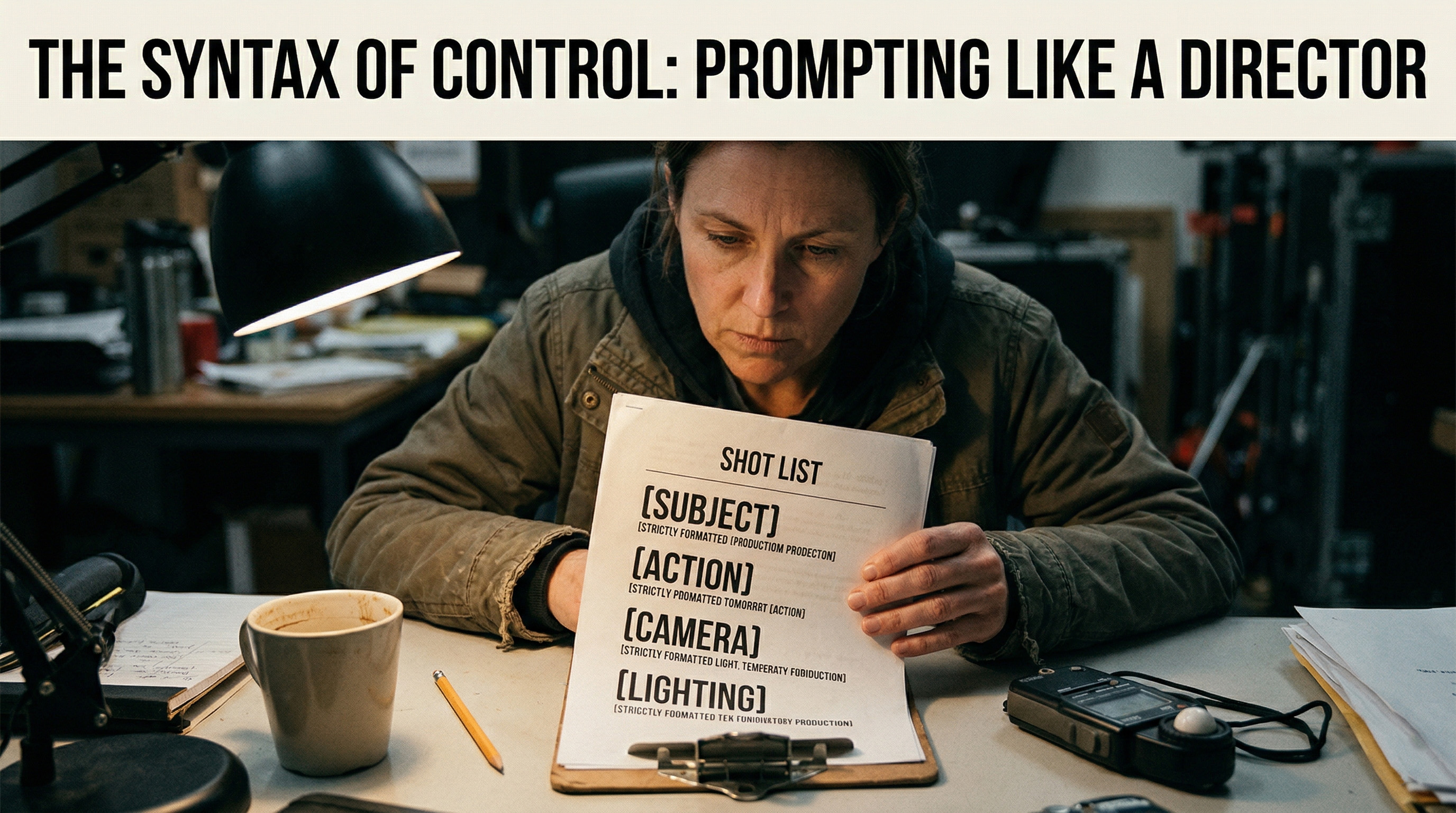
Abstract: Text-to-video systems do not interpret language the way a human director, cinematographer, or editor does. They do not read a prompt as intention. They parse it as weighted instruction: a compressed field of probabilities where nouns compete for identity, adjectives compete for style, and verbs compete for motion. This is why prompting skill is so widely misunderstood. Most users assume improvement comes from adding more descriptive language or collecting fashionable keywords. It does not. Mastery emerges when prompting stops being expressive and starts becoming structural. The difference is not vocabulary. It is syntax, hierarchy, and constraint. To make that visible, we can examine one simple scene, a man walking down a rainy street, through three different levels of operator: the Beginner, the Specialist, and the Veteran. Each stage reveals a different relationship to control, and each produces a different kind of failure or success.
Level 1: The Beginner (The Adjective Soup)
The beginner treats the model like an insecure collaborator that needs constant reassurance. The prompt becomes a pile of praise, quality labels, and aesthetic flattery. Instead of specifying action, blocking, or shot logic, the user throws mood words at the machine and hopes intensity will produce craft. This is the stage where prompting becomes decorative rather than directive.
A typical beginner prompt looks like this:
“Masterpiece, 8k resolution, ultra-realistic, epic cinematic lighting, handsome man walking in rain, trending on ArtStation, Unreal Engine 5.”
The structure of this prompt is revealing. Most of the tokens are not about what is happening. They are about what the user wants the output to feel like in the abstract. “Masterpiece” is not a direction. “8k resolution” is not a shot design choice. “Trending on ArtStation” and “Unreal Engine 5” are style associations borrowed from image culture, not motion language. Even “cinematic lighting” is too vague to be operational. Cinematic according to whom? Hard key? Sodium vapor? Backlit silhouette? High-contrast noir? The model is left to average across broad visual priors.
The result is predictable. The action collapses. The man may exist, the rain may exist, but the image often resolves into a polished portrait rather than a coherent moving shot. The face is overemphasized, the walking becomes ambiguous, and the scene drifts toward generic slow motion because the model has been given more style pressure than motion pressure. It does not know the priority of the request. It only knows the density of associations. So it produces the most statistically attractive compromise: a glossy human figure, wet atmosphere, shallow drama, weak blocking.
This is the first hard lesson in prompting: adjectives do not control time. They decorate a frame. If the model is under-specified in motion and over-specified in vibe, it will choose visual safety over physical clarity.
Level 2: The Specialist (The Technical Overload)
The second operator is more dangerous because they are more informed. They have discovered camera language, lens language, and production terminology. They know what a tracking shot is. They know what rim light is. They know the difference between fog, haze, and reflection. But instead of gaining control, they often drown the model in simultaneous demands. This stage mistakes technical vocabulary for directorial precision.
A typical specialist prompt might read:
“Shot on 35mm lens, f/1.4, ARRI Alexa, man in black trench coat walking exactly three steps forward, tracking shot that pans left while zooming in, volumetric fog from streetlamp, rim light on left cheek, puddles reflecting neon, photorealistic.”
At first glance, this looks more sophisticated. It sounds like someone who has spent time around production. The problem is that the model is not an on-set crew executing a shot list with shared physical space. It is a generative system trying to resolve a textual stack into a stable spatiotemporal sequence. When the prompt contains too many simultaneous constraints, especially conflicting ones, the shot begins to tear.
“Walking exactly three steps forward” is a good example of false precision. Human performers can count steps. Generative models do not count in that way. They approximate. The phrase injects rigidity without giving the system a usable motion rhythm. Likewise, “tracking shot that pans left while zooming in” is not impossible in cinema, but in a prompt it can become unstable because the model must infer camera translation, subject movement, reframing, and focal compression all at once. Add localized lighting instructions like “rim light on left cheek” while also demanding fog, neon reflections, and shallow depth, and the model has too many competing spatial anchors.
The result is not usually total failure. It is worse. The shot almost works, then mutates. The coat warps. The face drifts. The camera appears to hesitate between moves. Reflections do not obey perspective. The subject may appear to glide rather than walk because the system is trying to satisfy movement language and image beauty language simultaneously. This is the core weakness of technical overload: it sounds precise, but it distributes attention too evenly across incompatible instructions.
The specialist has advanced beyond adjective soup, but not yet reached command. They have learned the words of cinema without learning the hierarchy of cinema.
Level 3: The Veteran (The Structured Framework)
The veteran understands that a prompt is not prose. It is not a mood board sentence. It is not a behind-the-scenes equipment list. It is an operational blueprint. The veteran stops trying to impress the model and starts staging information in a strict order. This is where prompting becomes directorial rather than descriptive.
The professional standard framework is simple:
[Subject] + [Action] + [Context/Environment] + [Style] + [Camera Movement] + [Lighting/Mood] + [Audio Elements]
This format works because it restores hierarchy. The subject defines identity. The action defines temporal priority. The context defines spatial container. Style shapes texture without overriding motion. Camera movement is isolated as its own instruction. Lighting is separated from subject identity and motion. Audio elements, where supported, reinforce atmosphere without contaminating visual syntax.
A veteran prompt for the same scene would read:
“Subject: A man in a dark coat. Action: Walking forward at a steady pace. Context: A narrow city street at night, wet pavement. Style: Gritty, cinematic realism. Camera: Tracking shot moving backward, keeping the subject centered. Lighting: High-contrast streetlights, deep shadows. Audio: Heavy rain hitting the pavement, rhythmic footsteps.”
Notice what is absent. There is no pleading for quality. No empty superlatives. No contradictory lens fetishism. No decorative pile-up of brand names. The verbs are simple and usable: walking, moving, keeping. The subject has one clear identity. The camera has one clear job. The lighting is described in terms of visible effect, not gear mythology. Most importantly, every module answers a different production question.
This is also where experienced operators begin relying on pre-lit image anchors for style rather than forcing every aesthetic trait into the motion prompt itself. If the target look is highly specific, sodium vapor noir, blue-green industrial rain, harsh top-light with wet asphalt reflections, the veteran will often lock that look in still-image development first, then use the motion prompt to preserve action clarity. Style is anchored upstream. Motion is directed downstream. That separation is what makes the result clean, predictable, and directable.
The veteran does not attempt absolute control through density. They create reliable control through modular clarity.
Conclusion
The evolution from amateur to director in prompting is not a journey from simple language to complex language. It is a journey from undisciplined language to structured language. The beginner writes with desire. The specialist writes with terminology. The veteran writes with command logic. That distinction matters because generative video does not reward verbal enthusiasm. It rewards instruction architecture.
A real director does not stand on set and shout adjectives at the crew. A real director defines subject, action, space, camera, light, and mood in an order that can actually be executed. The same rule now applies to generative systems. The strongest prompts are not poetic performances for the machine. They are production documents written in miniature. True control begins the moment the operator stops trying to sound cinematic and starts building a shot the model can actually parse.