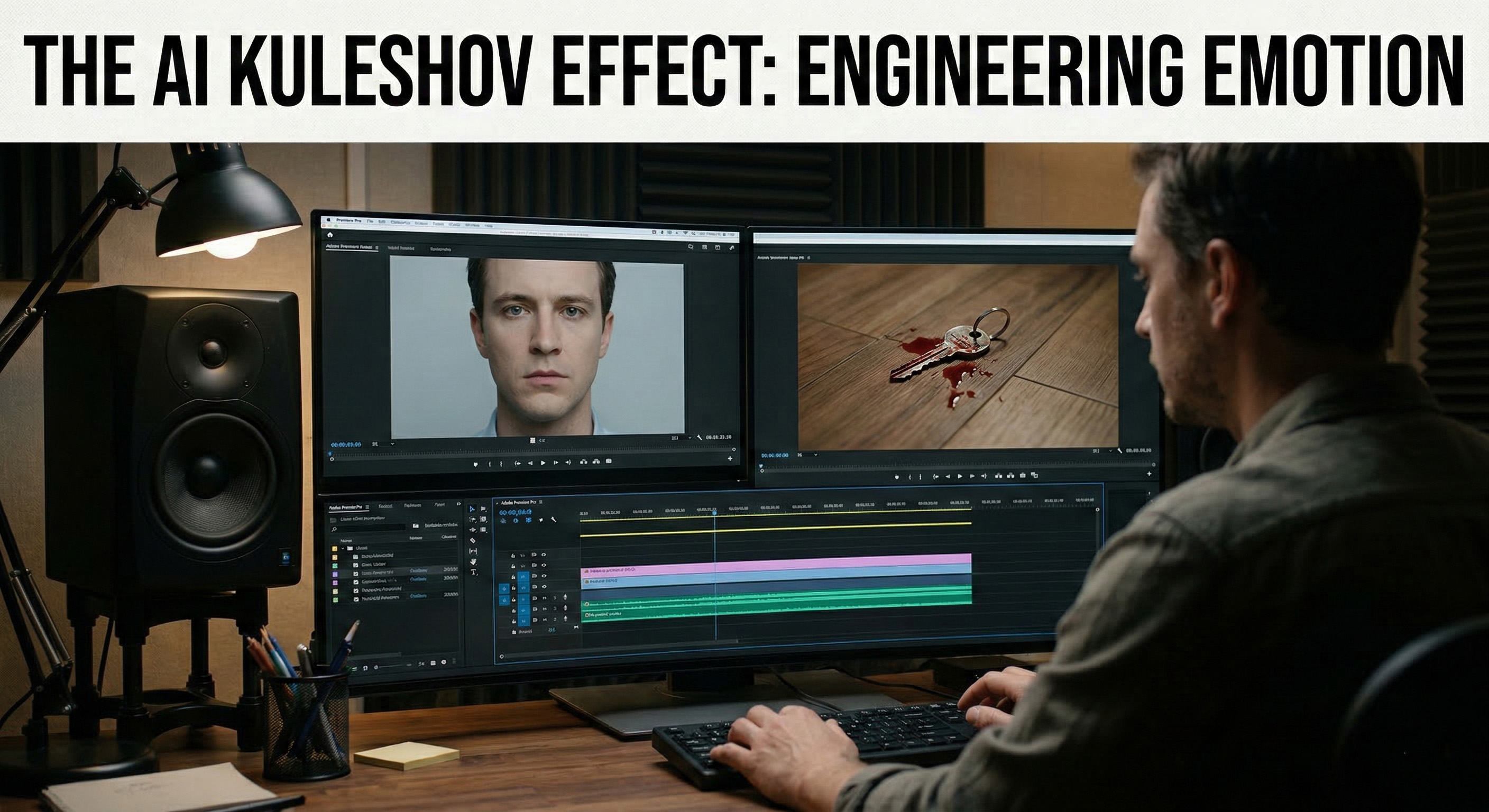
Abstract: Current AI video models excel at producing cinematic surfaces but struggle to sustain complex, high-fidelity human emotions. When pushed toward explicit expressions like grief or terror, synthetic faces often collapse into the "Uncanny Valley." This paper details Henrie Studio’s use of the Kuleshov Effect: a production strategy that relocates emotion from the generated face into the edit, using associative inserts to engineer meaning that the machine cannot yet simulate.
Current AI video models are remarkably good at producing surfaces. They can generate attractive faces, atmospheric lighting, and elegant camera drift in isolation. What they still struggle to deliver is sustained human emotion. Ask for fear, dread, or relief, and the result often collapses: a smile that lingers too long, an eye-line that drifts, or a micro-expression that mutates between frames. This is a structural limitation of synthetic video where temporal coherence remains a central technical challenge.
For the filmmaker, this matters because emotion is not decorative; it is the engine of the scene. When the face at the center of a sequence cannot reliably sustain subtle affect, the dramatic burden is threatened. The common instinct is to prompt harder, requesting more explicit performance. In practice, this only pushes the footage deeper into the Uncanny Valley, where faces look almost human but contain subtle, disturbing conflicts in motion.
The Methodology: Redesigning Where Emotion Lives
At Henrie Studio, we do not force the model to "act" harder. We redesign where the emotion lives by applying the Kuleshov effect. The principle is simple: a shot acquires its true emotional value through its juxtaposition with another shot. As our Creative Lead explains, the goal is not to have the emotion fully performed inside the face, but to induce the audience to project it there.
"Stop asking current models to carry the full emotional truth of a scene through facial acting alone. They are not dependable enough for that burden. Build faces that can survive scrutiny, then shift the emotion into the rhythm of the montage."
, Creative Lead, Henrie Studio
Phase 1: Prompting the "Blank Slate"
For the Kuleshov effect to work, the face must be emotionally open, neutral but "charged." We avoid prompting for named emotions like "terrified" or "grieving," which often trigger mechanical distortions. Instead, we prompt for restrained physiological life.
Our target is a face with low-amplitude internal activity: alert eyes, stable breathing, and minimal muscular noise. By reducing the performance load on the model, we generate footage that is photographic, stable, and, most importantly, interpretable. We aren't looking for emptiness; we are looking for a face that acts as a host for the viewer’s own inferences.
Phase 2: The Associative Insert
The real emotional event is relocated into the edit. Consider a sequence designed to convey guilt. Rather than a synthetic face "acting" guilty, we use a series of associative inserts, what we call "accusation devices."
A neutral face stares off-frame. Cut to a missed call on a phone. Cut back. Cut to a door left ajar. Cut back. Cut to a dropped key on the floor. By the third juxtaposition, the audience has finished the work the model could not do. The face is now read as stricken or morally implicated, not because the pixels changed, but because the edit built a field of implication around them.
"Effective inserts are not random B-roll. They are emotionally directional. They tell the audience that something happened, that someone failed, and that the face we return to exists inside that chain of failure."
Phase 3: Sound as Psychological Pressure
In a Kuleshov sequence, sound design functions as atmospheric pressure. It does not need to announce the emotion; it only needs to make the visual field feel morally or emotionally loaded. A distant room tone, a shallow breath, or the absence of expected ambience can stabilize the interpretation of a neutral face. Subtle sonic weight prevents the viewer from inspecting the synthetic image too closely, anchoring the "lie" of the edit in a physical reality.
Conclusion: Engineering Authorship
The AI Kuleshov effect is more than a workaround; it is a return to a fundamental cinematic truth. By respecting what synthetic video does well, generating fragments of photographic value, and avoiding what it does poorly, sustaining delicate emotional continuity, we maintain total narrative control.
A synthetic face does not need to perform everything. It only needs to hold long enough for the cut to make it meaningful. In the end, the machine gives us the pixels, but the montage creates the soul. That is not a compromise. It is authorship.