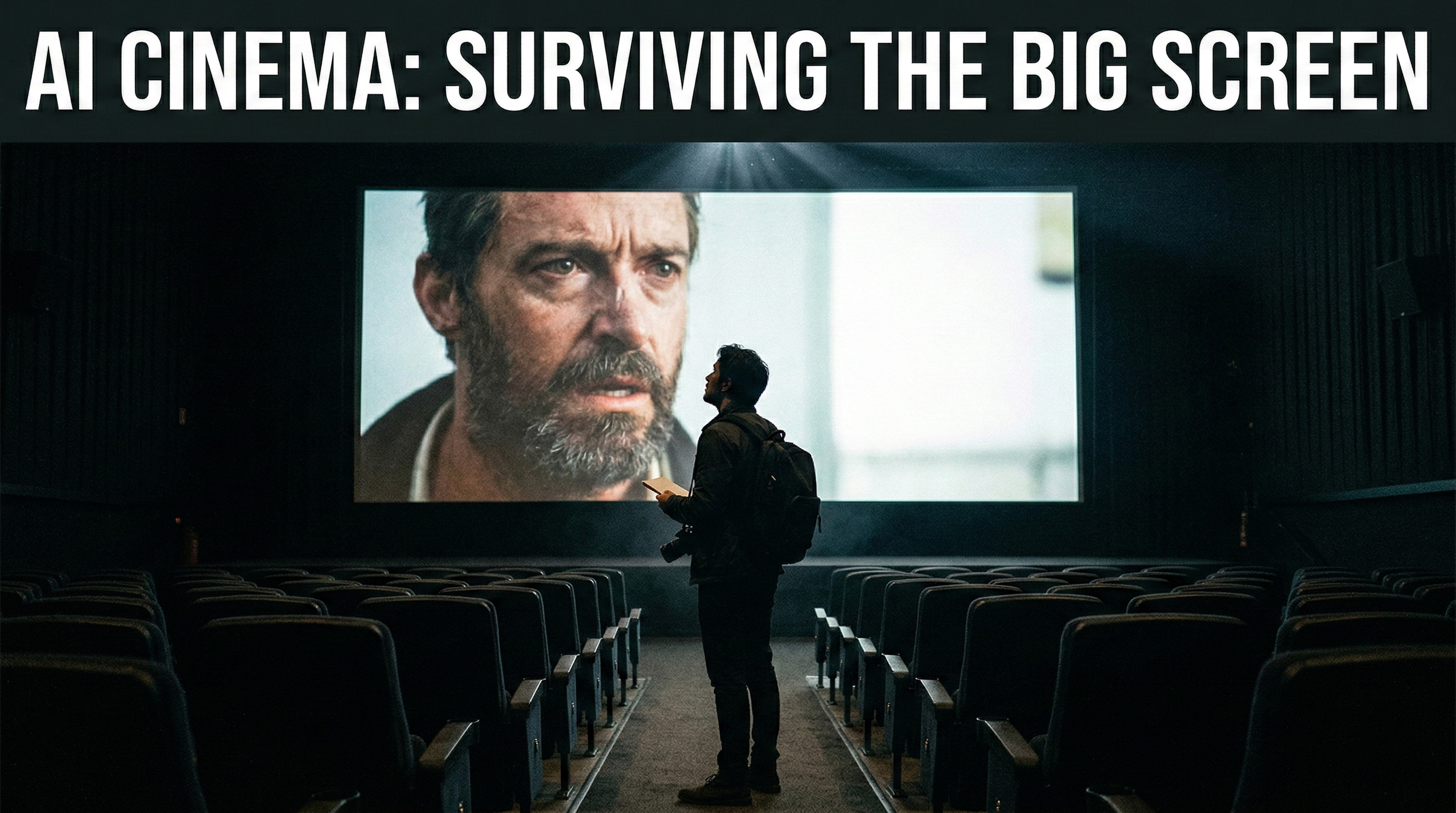
There is an immense difference between playing a film on a computer screen and seeing it projected in a theater.
On a workstation, many flaws go unnoticed. A slightly soft texture, a face that drifts for three frames... On the web, the eye is forgiving. In a theater, it forgives nothing. The image is magnified, the sound fills the entire room, and every weakness becomes glaringly obvious.
This is where the real challenge of AI cinema begins: not the generation, but the legitimization. How do you bring a work made with generative tools into a circuit where juries have been trained to recognize entirely different production pipelines?
The wrong answer is to disguise the film. The right answer is harsher: own the tool, but defend the directing. A jury doesn't need to love AI. It needs to understand why it was used.
Radical Transparency on Platforms
Today, festival submissions almost obligatorily go through centralized aggregators (like FilmFreeway). It is the industry's mandatory gateway, but the boxes to check are highly rigid.
For an AI film, the "Director's Statement" is not a decorative supplement. It is the space where mistrust is defused. The statement shouldn't say: "AI was used because it's new." It must assert: "This story required this method." Hiding the tool is useless; it must be stripped of its gadget status. A strong statement for a generative film should remain surgical:
- Why this story? (Substance over form)
- Why this method? (e.g., the need to create a mental texture or a shifting memory impossible to achieve in live-action)
- Why this festival? (Alignment with the event's editorial line)
Choosing Strategic Battles
The common reflex is to target Category A festivals right from the first render. But for an AI film, the initial goal isn't the summit: it's the laboratory. The resilience of the work must be tested against an external gaze.
Targeting selections open to new voices and emerging programs (like the First-Time Filmmaker Sessions) responds to a clear objective: measuring reception in a neutral environment. Do viewers tune out after thirty seconds? Does the story take precedence over the technology?
A "test" festival provides proof of legibility. And this proof later serves as a stepping stone for more demanding circuits.
The Golden Rule for a Jury: Economy of Means
This is where many AI films sabotage themselves. Out of a fear of emptiness, visual overkill takes over: too many movements, metamorphoses, and particles. The result is a visual mush that betrays a lack of mastery.
The golden rule for solid AI filmmaking is the exact opposite: simplification.
Require simple shots and readable framing. The image sets an atmosphere, but it shouldn't be asked to carry the entire dramatic performance. In an AI film tailored for festivals, sound does more than half the work:
- Sound design gives material density to generated objects.
- Voice-over ensures emotional continuity.
- The rhythm of the edit replaces the organic continuity that the image sometimes lacks.
If the story is solid and the sound is impeccable, the technology stops being a distraction. It fades behind the narrative.
Technical Reality Check: Standardizing Deliverables
As soon as a theatrical screening is targeted, web standards must be forgotten. An AI film must be finalized with the exact same requirements as a traditional film.
- The Image: Clean upscaling is non-negotiable. The big screen is cruel to compression artifacts and overly "plastic" textures.
- The Sound: A cinema-standard mix is essential. A theater instantly reveals hazardous spatialization or poorly placed vocals.
- The Format: The DCP (Digital Cinema Package). This is not a chic technical option; it is the standard and universal projection format for movie theaters. Without a DCP, physical festival screenings are impossible.
An AI film must not only be generated; it must be finished. And finishing is an integral part of directing.
Conclusion
AI is not an exemption from cinema. It is a new camera, with its own language, limits, and textures. The industry will accept it the day enough works prove they can pass a jury and leave a lasting mark after the theater fades to black.
The challenge is not to make people forget the tool, but to make the film impossible to ignore.