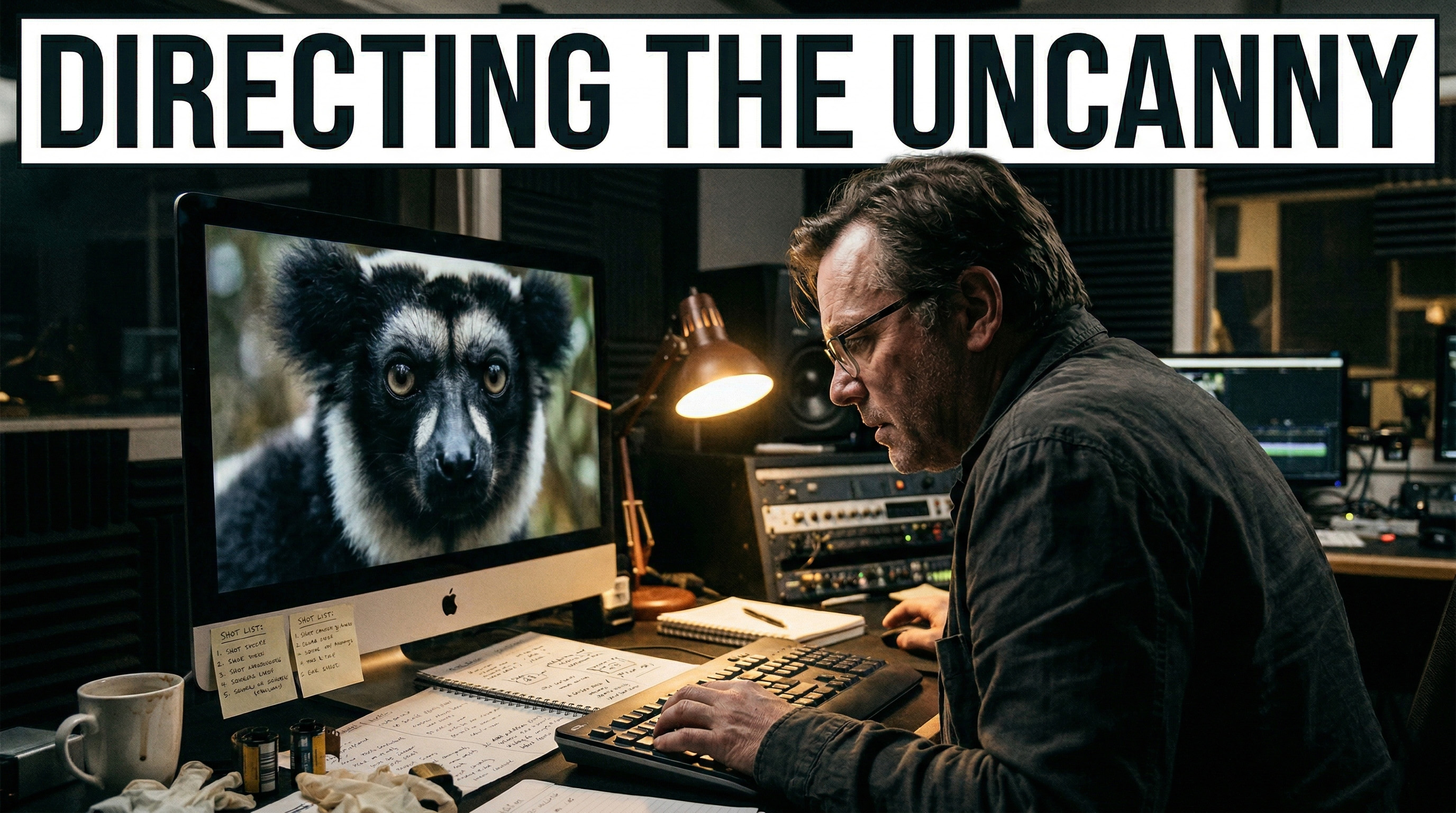
Abstract: The industry has reached a strange plateau. Beautiful people are easy now. Give almost any current model a clean prompt, a flattering lens description, a cinematic lighting cue, and it will return a face that looks expensive. Symmetry is cheap. Skin is cheap. Mood is cheap. The surface grammar of human beauty has been absorbed so deeply into the training corpus that photoreal human aesthetics are no longer a serious benchmark of fluency. They are the baseline. That is why studios that still lead with beautiful faces as proof of capability are advertising the wrong thing.
The Anatomy of the Unknown
Human appearance is where the models are most comfortable. The dataset is dense, the visual priors are familiar, and the errors are often forgiven because audiences are already trained by fashion, advertising, and portrait photography to accept a wide range of stylization. The model has seen millions of versions of the same problem. It knows how to imitate glamour. It does not yet know how to obey direction.
Real mastery begins where the model loses confidence. It begins when the subject is rare, anatomically specific, emotionally demanding, and placed inside a scenario that the training data never standardized. That is where the studio stops being a prompt vendor and starts becoming a director. At Henrie Studio, we call this non human casting.
Take the Indri lemur. Not a generic lemur. Not a cartoon primate. Not a cute animal placeholder with big eyes and soft focus. An Indri. The silhouette matters. The limb proportions matters. The distribution of fur matters. The face cannot collapse into a monkey, a cat, or a toy. The body has to carry weight correctly. The posture has to suggest species level truth even when the scenario itself is implausible. The moment you ask that character to perform, to hold emotional gravity, to deliver dialogue, or to move through a scene with continuity, you are no longer asking for a pretty image. You are asking the model to solve physics, anatomy, and performance at the same time.
This is where most AI work breaks. Generic prompting produces generic biology. Fur turns decorative instead of structural. Limbs drift. Joint behavior becomes ambiguous. The face loses the exact ratios that define the species. Once motion enters the frame, the failure compounds. Fur does not just have texture, it has direction, density, compression, lift, and inertia. A creature with a distinctive body plan cannot move like a human in a costume. If it does, the audience feels the lie immediately, even if they cannot explain it technically. Uncanny failure is often not a rendering problem. It is a directional problem.
Performance Over Prompting
To direct a non human actor, the studio has to become aggressively specific. The anatomy must be locked before the performance is asked for. The emotional register must be defined before the dialogue is introduced. The camera language must protect the character instead of exposing the model’s weakest guesses. We do not chase perfection through longer prompts. We build control through structured intent. That means separate decisions for silhouette, surface behavior, locomotion, eyeline logic, mouth articulation, and emotional state. Every one of those decisions affects the others. Every shortcut gets punished on screen.
The hard part is not generating one strong image. One strong image proves almost nothing. The hard part is preserving the same character across multiple clips while changing angle, distance, action, and intensity. A non human actor has to survive coverage. It has to survive close observation. It has to survive speech. If the creature looks emotionally heavy in one clip, then slips into mascot energy in the next, the illusion is dead. If the jaw mechanics fail during dialogue, the authority is gone. If the fur pattern drifts between shots, continuity collapses. Performance is where the studio earns its reputation, because performance is where latent instability becomes visible.
This is also why we reject the lazy fantasy that AI cinema is just prompt craft. Prompting is only the front door. Direction begins after the first output. The studio must decide what emotional truth the character is carrying, what physical behaviors will communicate that truth, and what technical sacrifices are acceptable to protect the illusion. With a non human actor, emotional nuance is especially difficult because the model tends to simplify. It pushes toward cute, exaggerated, or legible in the broadest sense. Serious direction pushes the opposite way. It asks for restraint, weighted gaze, deliberate stillness, and the kind of micro expression that does not turn the creature into a parody of a human. That requires discipline. It also requires knowing when to reduce motion, when to hide articulation, when to redesign the blocking, and when to rebuild the shot entirely.
The Commercial Proof
An Indri lemur delivering precise dialogue in an implausible scenario is not a gimmick for us. It is a stress test. If the studio can preserve anatomical integrity, believable fur physics, emotional seriousness, and speech synchronization under those conditions, then the studio has demonstrated something much more valuable than novelty. It has demonstrated control.
Brands should care about this far more than they think. The commercial world keeps asking whether a studio can make a watch look premium, a car look aerodynamic, a bottle catch light correctly, or an abstract campaign concept feel tangible. Those are valid questions, but they are easier questions. A luxury watch movement has complexity, yes, but it does not blink with species specific behavior while carrying sadness in its posture. A car reflection is technically demanding, but it is still an object. A non human actor is the harder problem because it combines object fidelity, character consistency, motion logic, and emotional persuasion in one frame.
That is why non human casting is such a powerful proof of craft. If a studio can force the model to respect the physics and feeling of an exotic animal under dramatic pressure, then it can absolutely handle a difficult product surface, an unusual material, or a conceptual brand film that requires visual metaphor without losing coherence. The hardest challenge reveals the deepest competence. The exotic creature becomes a diagnostic tool.
Conclusion
The future of AI filmmaking will not belong to the people who can generate the cleanest face. It will belong to the studios that can direct uncertainty into intention. That means mastering the zones where the model is least trained, least stable, and least forgiving. The non human actor sits exactly in that zone. It is not there to show off. It is there to expose whether the studio understands direction at a level deeper than output.
The best AI filmmakers do not ask the machine for images and hope something useful appears. They build performance, control behavior, and pressure test every layer of the illusion until the screen stops looking generated and starts looking directed. The non human actor is not a novelty. It is the filter. It separates technicians from artists, and prompt operators from studios that actually know how to command the latent space.