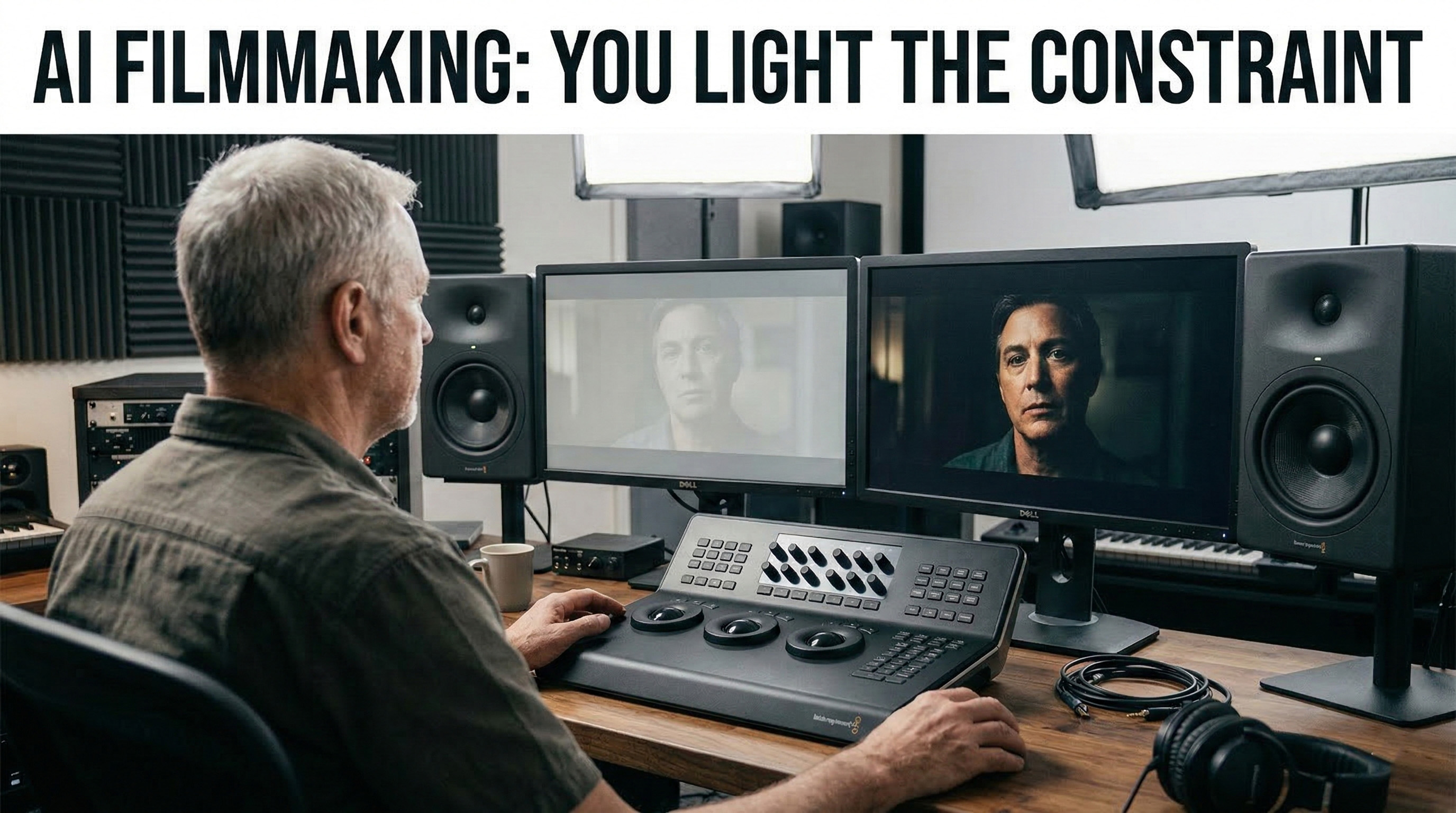
Abstract: Generative video models are very good at producing motion and very bad at respecting light as a physical system. Left alone, they tend to drift toward broad, commercial illumination: readable faces, lifted shadows, glossy surfaces, and a clean, evenly exposed frame that feels less like cinema than a polished game trailer. The problem is not simply taste. It is structural. Text prompts describe mood better than geometry, and current models interpret lighting as a semantic style cue rather than a disciplined arrangement of source, falloff, occlusion, and ratio. If the goal is true cinematic contrast, chiaroscuro, deep negative space, sculpted faces, volumetric depth, the workflow has to be reversed. The light must be engineered first in static reference images, then preserved during motion generation with minimal semantic interference, and finally rebuilt in post through aggressive grading and texture work. In generative video, you do not light the set. You light the constraint.
The Problem: The Flatness of the Machine
A director of photography does not ask for “moody lighting” and go home. We place a key. We control its height. We decide whether the fill is passive or active. We cut spill. We shape shadow. We decide what part of the face gets permission to disappear. Lighting is not decoration. It is narrative pressure.
That is exactly where generative video still breaks.
You can write “dramatic low-key portrait, hard side light, deep contrast, volumetric haze,” and sometimes the model will give you an image that appears to comply. But the compliance is superficial. It is giving you the statistical look of drama, not the physical logic of a lit scene. It can imitate the memory of a shadow pattern without understanding why that pattern exists. That is why the results so often feel correct for one second and fake the longer you inspect them. The face is readable, but not sculpted. The background is dark, but not deliberately held. Highlights bloom in random places. Contrast exists, but it is not organized.
People new to the medium keep trying to solve this with more words. Move the key light ten degrees. Lower the fill. Add negative fill camera right. Increase contrast ratio. The prompt grows more technical and the output grows more unstable. That is because the model is not operating like a gaffer taking notes on set. It is resolving a cloud of language into a plausible image. Light, in that process, becomes vibe. Vibe is not geometry.
The result is the now-familiar AI sheen: evenly legible, plastically clean, and strangely timid about darkness. The latent space likes visibility. Visibility is safe. Deep shadow removes information, and these systems are biased toward preserving information. Real cinematography often does the opposite. It withholds.
Phase 1: The Pre-Lit Anchor
So the professional workflow starts in the still image.
Before I ask a video model for motion, I want a frame that already contains the lighting argument. Not a moodboard. Not a pretty reference. A locked image with intentional black levels, deliberate highlight placement, controlled facial falloff, and a clear separation between what lives in light and what is allowed to die.
This is the pre-lit anchor.
It has to be built more aggressively than the final shot should look. That part matters. If the still is merely tasteful, the animation stage will soften it into mediocrity. If the still is bold, harder blacks, tighter highlight control, more decisive negative space, some of that structure survives the translation into motion. The model will almost always average things out. You have to start from an image that can afford the loss.
This is where traditional image discipline becomes useful again. Dodge and burn the face. Kill the weak parts of the frame. Tighten local contrast. Shape practicals. Cut the ambient mush. Build separation between foreground, subject, and background so the light has hierarchy before time is introduced. If you want chiaroscuro later, you need a still that already behaves like a finished frame from a graded film, not a neutral render waiting to become cinematic.
In live-action, the set is stable and the light is applied to it. In generative video, neither the set nor the subject is stable enough to trust under motion. So you lock the image first. The still becomes your proof of intent. It tells the video model, in the most forceful language it understands, what the shot is allowed to be.
Phase 2: Semantic Restraint in Motion
This is the part almost everyone ruins.
They generate a strong pre-lit still, then panic and over-explain the motion prompt. They add lighting adjectives again. Cinematic shadows. Golden rim light. Soft haze. Moody practical glow. Atmospheric diffusion. At that point they are not protecting the shot. They are reopening it.
Once the still has solved the light, the video prompt should become narrow and functional. Motion only. Head turn. Slow push-in. Cloth drift. Hair movement. Atmospheric dust. Small camera breathing. Maybe a controlled gesture. That is it.
The moment you start re-describing the light during animation, you invite the model to reinterpret the frame according to its own internal average of what those words mean. That is how hard contrast gets washed out. That is how shaped darkness turns into generic ambience. That is how a carefully built cheek shadow becomes a soft beauty-light compromise because the model heard “cinematic” and reached for the wrong memory.
The paradox of good AI directing is that control often increases when language decreases. A well-anchored still plus a restrained motion instruction usually produces stronger footage than a brilliant paragraph trying to micromanage every cinematic quality at once. In practical terms, the video model should be animating an already-lit image, not relighting a moving scene from scratch.
Phase 3: The Digital Intermediate
Even then, the raw clip is not finished. It is not close.
AI footage arrives with the same lie every time: it looks polished until you put it on a timeline next to anything real. Then the weaknesses show up fast. Blacks are thin. Midtones are too polite. Highlights feel synthetically clean. Skin has that sealed, airbrushed surface. Motion may survive, composition may survive, but the image still lacks weight.
This is where the digital intermediate stops being optional.
In Resolve, the first job is to restore tonal authority. Rebuild the black floor without crushing the frame. Control highlight roll-off so bright areas feel photographic instead of algorithmically bright. Recompress the image until the eye knows where to rest. The raw generation usually wants the whole frame to remain legible. Cinema does not. Cinema applies pressure.
Then comes texture. Grain is not an Instagram garnish. It is a unifying layer that breaks the plastic smoothness and helps hide the micro-cleanliness that gives AI away. Halation helps practicals and hard edges feel less sterile. Controlled diffusion can take the edge off the synthetic sharpness. Sometimes a little bloom around highlights is the difference between “generated image” and “captured image.”
For short-form brand work, this matters even more than people admit. A social ad can survive stylization. It cannot survive looking weightless. If the lighting feels generic, the frame becomes forgettable no matter how expensive the subject matter looks. What stops the scroll is not just movement. It is visual conviction. Contrast. Shape. Intent.
That is why post is not a finishing touch in AI video. It is where authorship returns.
Conclusion
The mistake is thinking these tools have replaced cinematography because they have replaced the camera.
They have not.
They have replaced one capture method with another, but they have not removed the need for judgment. Someone still has to decide where the frame gets dense, where the face falls off, where the blacks begin, where the highlight stops, and what the audience is denied. That is cinematography. It does not disappear because the image came out of a model instead of a sensor.
If anything, generative video has made those instincts more valuable. The machine is perfectly capable of generating images. What it cannot do reliably is defend a visual idea against its own tendency toward average. That still takes a human who understands light as structure, not mood.
Technology can replace the camera.
It still cannot replace the DP.