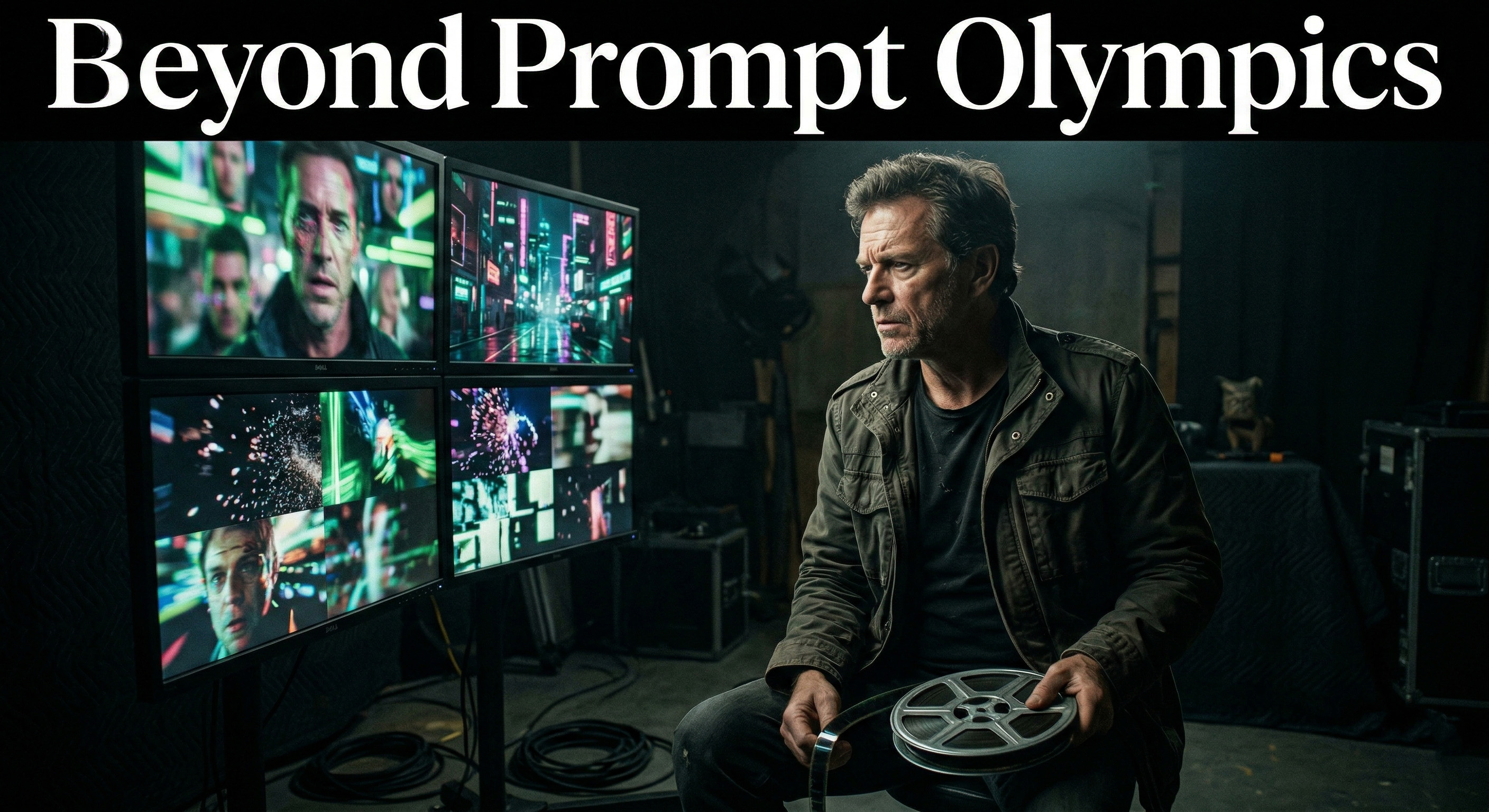
AI video competitions have created a strange illusion. They make the industry look like a meritocracy of pure craft, when in reality they often reward a narrower skill: the ability to generate a burst of spectacle inside a tiny time window. A hyper-polished 10-second clip appears, everyone gasps, the judges nod, and the creator is treated like a visionary. Then the clip ends, and nothing remains except the afterimage of a technical trick.
That is the Prompt Olympics.
You know the visual language by now. Unmotivated hyper-slow motion. Endless morphing transitions. Chrome-skinned humanoids walking through hyper-detailed cyberpunk cities. Fabric simulations with no narrative function. Particles, lens bloom, impossible camera moves, faces that look expensive but feel spiritually vacant. It is beautiful, sometimes genuinely beautiful, but it is also a hollow spectacle. It proves that you can pull the lever on a slot machine until the latent space gives you a jackpot. It does not prove that you can direct.
A film is not a jackpot. A film is a sustained act of control.
That distinction matters because the current competition circuit often confuses image generation with filmmaking. It rewards the isolated miracle, not the durable system behind it. It celebrates the clip that can survive ten seconds of scrutiny, not the work that can survive ten minutes of narrative pressure. And that pressure is where most AI creators collapse.
The Continuity Test
The real flex in AI filmmaking is not producing one immaculate fragment. It is preserving world logic when the model wants to wander. It is maintaining character identity when the engine wants to mutate. It is sustaining emotional tension across multiple beats when the tool keeps offering visual novelty as a substitute for dramatic progress. That is why continuity is the real test, and competitions almost never test for it.
Anyone can produce a seductive clip if they generate enough variations. Very few can build a serialized world that holds together chapter after chapter. That is the discipline required in episodic storytelling, the kind of discipline demanded by a series like Glint, where distinct chapters such as Treasure Seeker and Asha and the Seeds cannot feel like unrelated prompt experiments wearing the same logo. They need a shared grammar, a stable emotional universe, and an internal logic that survives scene changes, tone shifts, and character recurrence. That is not prompting. That is authorship under constraint.
Competitions rarely care about that level of stamina. They judge the sprint, not the season. They reward the shot, not the structure. They do not ask whether your world can sustain narrative escalation across episodes. They do not ask whether your protagonist still feels like the same person once the camera angle changes, once the wardrobe changes, once the lighting changes, once the plot asks for vulnerability instead of visual fireworks. They certainly do not ask whether your ending earns what your opening promised.
The Festival vs. The Feed
And then there is the audience problem.
A tech jury and a human audience are not the same organism. A tech jury is often primed to admire the mechanism. It notices fidelity, coherence tricks, motion quality, texture behavior, the density of the render, the shock of the new. A human audience notices something else: whether they care. Traditional human-curated festivals understand this instinctively. A platform like First-Time Filmmaker Sessions does not care what model generated your frame. It cares whether your piece has rhythm, vulnerability, restraint, and a reason to exist beyond technical display. It cares whether your story breathes.
That is why a piece like Lily and the old man matters more than fifty clips of neon gods walking through digital rain. Quiet human connection is harder than spectacle. Spectacle can hide emptiness. Emotional honesty cannot. If two characters share a frame and the moment lands, the audience forgives imperfections. If the frame is flawless but the feeling is dead, the audience leaves with nothing. Competitions built around technical astonishment often miss this because astonishment is easy to score. Heart is harder. Pacing is harder. Restraint is harder. Human tenderness is harder. They are also closer to what cinema has always been.
The Commercial Reality
Now bring this back to the commercial world, because that is where the fantasy really breaks down.
Clients do not pay for latent space gymnastics. They pay for outcomes. In the B2B and agency world, the brief is usually brutal in its simplicity. Get attention fast. Hold it. Deliver a message. Make the brand memorable. Move the viewer toward action. If you are building a social branding video for a demanding client like LeadGenHub, nobody in the room is asking whether your morph transition won a niche Discord challenge. They are asking whether the opening hook stops the scroll, whether the idea is clear in under three seconds, whether the pacing creates retention, and whether the final output supports conversion.
That is where many competition winners get exposed. They have trained for applause, not for function. They know how to create a visual spike, but not how to build a communication asset. They can make a machine hallucinate something dazzling, but they cannot structure a message, manage emphasis, or design an emotional arc around a business objective. In real studio work, AI is just the renderer. The strategy has to come from a human brain. So does the edit. So does the taste. So does the restraint. So does the decision to cut the pretty shot because it weakens the story.
Conclusion
This is the uncomfortable truth underneath the current wave of AI competitions: many of them are not measuring filmmaking maturity. They are measuring a form of technical opportunism. That has value, but only a narrow kind. It can reveal who is fluent with a tool. It cannot reliably reveal who can build a film, carry a character, protect continuity, guide emotion, or solve a client problem under pressure.
The industry needs to stop pretending those are the same skill.
Winning an AI contest may prove that you are a sharp prompter, a patient experimenter, or a gifted image hunter. Fine. Those are real abilities. But they are not the whole job, and they are certainly not the highest level of the job. Delivering emotion, continuity, and commercial results, that is what makes you a studio.
Winning Prompt Olympics makes you look impressive for ten seconds. Building work that can survive a series, a festival screen, or a hard client brief, that is the standard that matters.