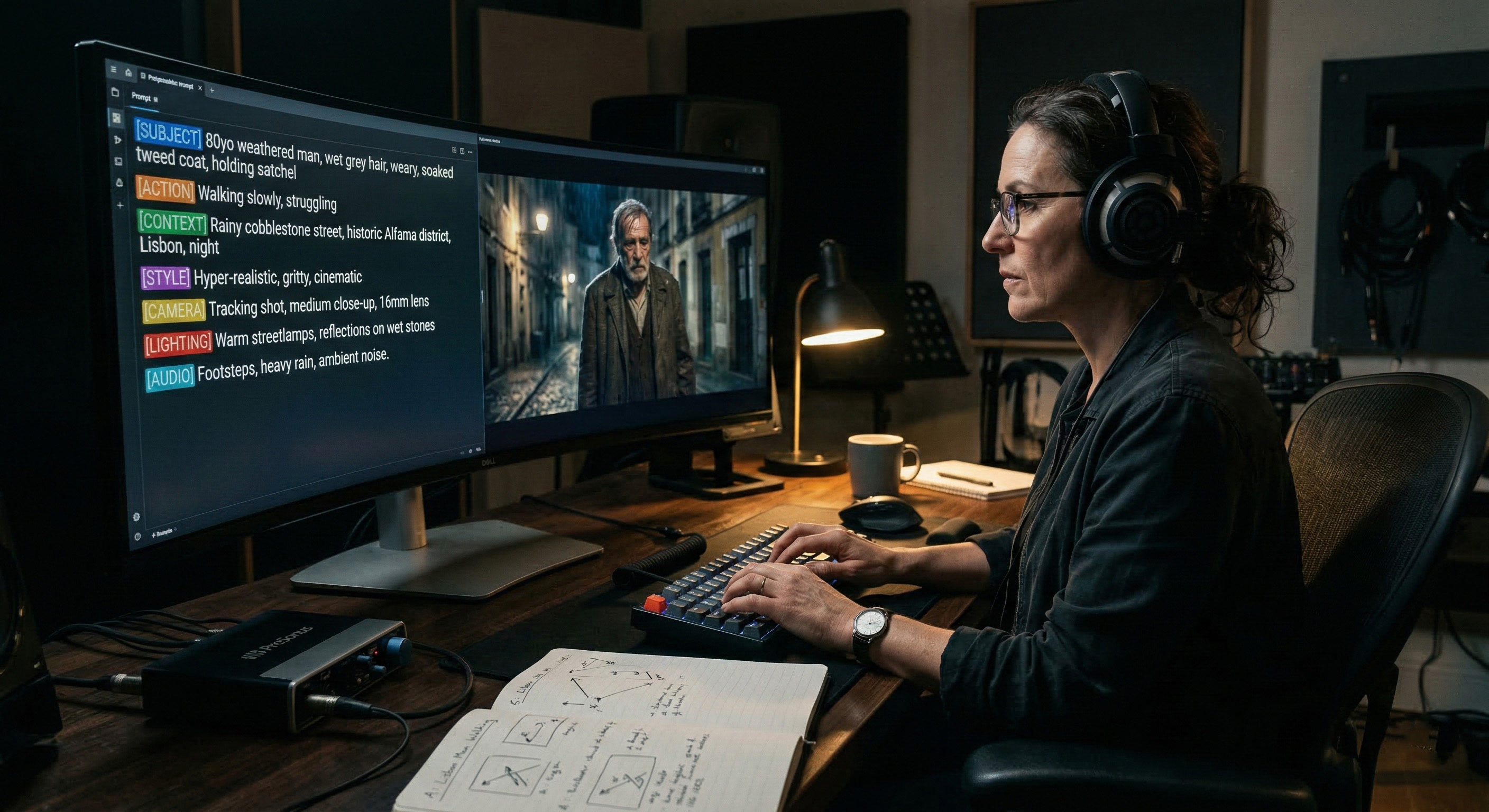
We’ve all been there. You type a vague sentence into an AI video generator, hit enter, and the result looks more like a fever dream than a cinematic shot. The problem is rarely the tool. The problem is us. More specifically, the problem is our prompt.
A great video prompt isn’t a literary description; it’s a technical shooting script compressed into a few lines. Every word matters. Every missing word is a void that the AI will fill on its own, and its "creative choices" are rarely yours.
After hundreds of generations, I’ve identified seven pillars that, when combined systematically, transform a mediocre prompt into a professional cinematic directive. Let’s break them down.
Pillar 1, The Subject: Who or what occupies the frame?
Every cinematic shot begins with a subject. The AI needs to know exactly who or what it’s showing. "A woman" is blurry. "A woman in her late seventies, short white hair, sun-weathered face, wearing a soil-stained linen apron" is a character.
Subject precision determines visual consistency. The more specific you are about age, texture, clothing, and proportions, the more constraints the AI has to converge toward a credible image.
Pillar 2, The Action: What is the subject doing?
A static subject is a photo. Cinema is movement. Action must be described with precise verbs and, ideally, a rhythm. "She walks" says nothing. "She walks slowly through rows of lavender, grazing the stems with her fingertips" gives the AI dynamics, speed, and physical interaction.
Think in terms of micro-gestures. These are what create emotion: a glance turning away, a hesitant hand, or a breath visible in the cold air.
Pillar 3, Context & Environment: The living set
The background isn't just wallpaper; it’s a silent character. Specify the era, location, season, weather, and dominant textures. "In a kitchen" is a visual void. "In a 1970s Provencal kitchen, cracked terracotta tiles, window open to a dry garden, dust motes dancing in a ray of light" is a world.
AI excels when given sensory anchors, concrete details that allow it to build spatial coherence.
Pillar 4, Style: Imposing the visual aesthetic
This is where most creators forget to be directive. The visual style must be explicitly named. You can reference a genre ("Italian Neorealism"), a technique ("Shot on 16mm film, visible grain"), an aspect ratio ("2.39:1 anamorphic"), or even a specific cinematographer’s look.
Terms like film grain, shallow depth of field, desaturated color palette, or soft focus act as powerful aesthetic filters. Without them, the AI produces a generic, "AI-looking" render.
Pillar 5, Camera Movement: Directing the eye
A shot is a point of view in motion. Specify the movement: slow dolly in, horizontal pan from left to right, handheld steadicam shot, fixed low-angle, or progressive optical zoom.
Also, indicate camera height (ground level, shoulder height, bird's eye view) and distance (extreme close-up, medium shot, wide shot). these parameters radically change the emotional weight of a scene.
Pillar 6, Lighting & Mood: Sculpting with light
Light is the true language of cinema. Name your source: natural side-lighting from golden hour, cold blue-green neon, harsh backlight, or flickering candlelight.
The emotional atmosphere stems directly from this pillar. The same scene lit in soft gold or harsh white tells two completely different stories. AI responds remarkably well to these technical lighting cues.
Pillar 7, Audio Elements: Sound as a narrative directive
In the latest generation of models (like Veo), sound is no longer an afterthought, it’s generated natively with the image. Describe the soundscape as part of your prompt. "Complete silence, only the sound of the wind" pushes the AI toward a contemplative visual.
For dialogue-heavy models, write it like a script: "Character: [Specific Dialogue]". Even if you aren't generating audio, these markers function as intent indicators that the AI translates into visual rhythm.
The Proof: Bad Prompt vs. Excellent Prompt
Mediocre Prompt:
"An old man in a street in the rain, cinematic style."
Probable Result: A generic man, a generic street, generic rain. No emotion. No direction.
The 7-Pillar Prompt:
"A man in his eighties, hunched back, worn tweed coat, soaked beret, walking alone on a narrow cobblestone street in Lisbon. He stops in front of a dark storefront and stares at his own reflection. Late afternoon, autumn, continuous light drizzle. Neorealist style, shot on 35mm film, desaturated colors, visible grain. Slow tracking shot at waist height, the subject moves further away into the frame. Diffuse natural light, lead-grey overcast sky, reflections on the wet stones. Only the sound of rain on roofs and the man's irregular footsteps on the stone."
The Golden Rule: Think in Shots, Not Stories
The most common mistake is trying to tell a whole story in one prompt. AI generates shots, not narrative sequences. Each prompt should correspond to a single shot, one main subject, one action, and one camera movement.
The editing is your job. The shot is the AI's. When you respect this boundary, you stop fighting the tool, and you start directing with it.