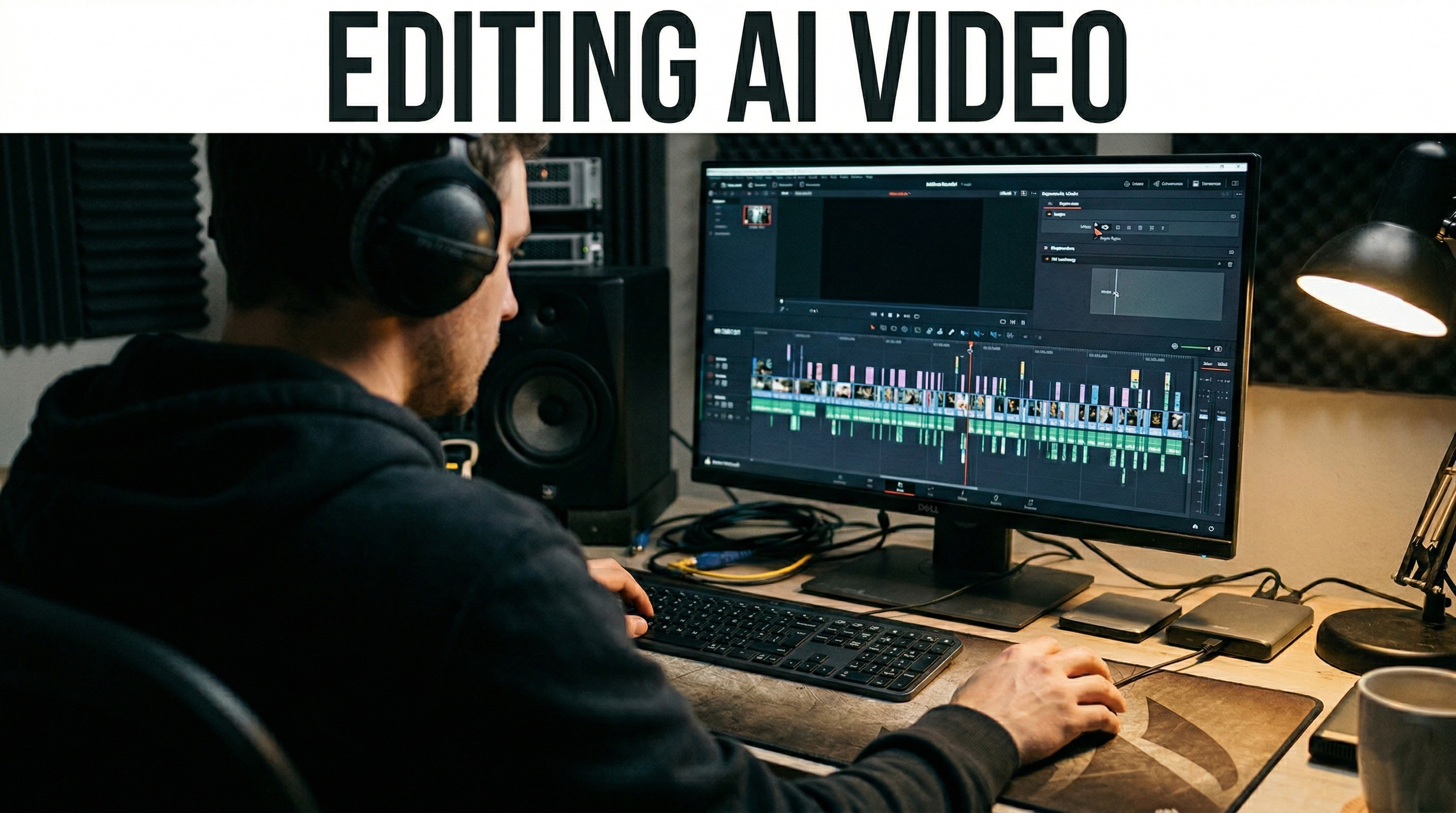
Abstract: Generative video models do not produce scenes. They produce moments: short bursts of probabilistic motion that simulate continuity for a few seconds before the image begins to drift away from itself. This is the central technical limitation shaping AI filmmaking today, and it is why so much discourse around prompting misses the real production bottleneck. The problem is not only how to generate a better shot. The problem is how to build time out of fragments that have no reliable memory of one another. In traditional filmmaking, the editor sculpts duration by reducing excess footage from a coherent performance captured in coverage. In generative filmmaking, the editor is doing something more structural. They are assembling isolated micro-shots into the illusion of a continuous event. The job is no longer merely to cut. It is to impose temporal logic onto footage that naturally resists it.
The Problem: The 5-Second Collapse
Every experienced editor working with generative video runs into the same wall. The first two seconds look promising. By the third, the shot begins to wobble. By the fifth, identity decay, perspective drift, and physics instability start creeping into the frame. A smile changes shape. Fingers fuse. The background forgets its own geometry. A coat collar mutates between frames. Eye lines slide off target. The model is not failing in some incidental way. It is revealing the underlying condition of the medium.
These systems do not understand time as a filmmaker understands time. They do not maintain dramatic continuity, spatial continuity, or character continuity across extended duration. They simulate motion by extending a latent prediction forward, but the longer the clip runs, the more fragile that prediction becomes. The beginning of the shot exerts less influence on the end of the shot than most users assume. What feels like a continuous scene is often just a short-term agreement between adjacent frames. After a few seconds, that agreement degrades.
This is why the dream of prompting a clean 30-second dramatic take is still mostly fantasy. You can ask for it. You can describe the camera move, the emotion, the blocking, the weather, the lens, the wardrobe, the mood. But description does not create temporal memory. A text prompt can shape the initial condition of a shot. It cannot guarantee stable identity and coherent cause-and-effect across long duration. Put three generated five-second clips back-to-back and you do not suddenly have a fifteen-second scene. You have three separate weather systems colliding in the timeline.
The amateur mistake is to interpret each fragment as a miniature master shot. The professional response is to accept that these fragments are unstable by design and build an editorial grammar around that instability.
Phase 1: Generating Coverage (The Glue)
The first major shift is conceptual. Most beginners generate only hero shots: wides, sweeping camera moves, heavily composed “cinematic” frames meant to carry the whole scene. This is exactly backwards. In AI filmmaking, the widest and most ambitious shots are often the least structurally useful because they expose the model for too long. They ask continuity to survive under maximum scrutiny.
Professionals think in coverage. Not coverage in the old production sense of a scheduled shot list captured on set, but synthetic coverage generated specifically to rescue the scene from collapse. That means hands on a table. Boots hitting wet pavement. A cup placed on a counter. A shoulder turning. A blinking eye. A door handle. Steam rising from coffee. The hem of a coat in wind. These are not ornamental inserts. They are load-bearing editorial materials.
Coverage is the glue because it gives the timeline places to breathe and places to hide. If your A-roll clip starts disintegrating at second four, you need something to cut to at second three and a half. A close-up of fingers tightening around a glass buys you a second. A cutaway to a train wheel, a curtain moving, or a reaction shot buys you two more. These micro-shots do not need to carry plot on their own. They need to absorb discontinuity.
This is where generative filmmaking starts resembling construction more than capture. You are not recording an event from multiple angles. You are manufacturing a set of editorial escape hatches before the footage betrays you. Good AI editors do not just ask, “What is the main shot?” They ask, “What are the fragments that will allow this main shot to survive in the timeline?”
Phase 2: The Sound Bridge (Anchoring the Lie)
Visual continuity in generative video is weak. Audio continuity is where you stabilize the illusion.
Human perception is far more forgiving of visual discontinuity when the soundtrack remains coherent. If room tone stays continuous, if footsteps track smoothly across cuts, if the distant train rumble or fluorescent buzz does not break, the edit feels motivated. The audience experiences the shot sequence as one unfolding event rather than three unrelated generations. This is why sound in AI filmmaking is not secondary finishing work. It is structural.
Continuous room tone is the base layer. Without it, every cut feels like a reset. Foley provides tactile persistence: fabric rustle, chair creak, glass clink, heel impact, breath. Then come J-cuts and L-cuts, which are no longer stylistic luxuries but survival tools. Let the next clip’s sound arrive before the image changes. Let the previous clip’s sound hang over the incoming shot. These overlaps smooth the temporal fracture between two clips that may not match visually at all.
If a passing train begins in clip A, continues through clip B, and fades under clip C, the brain links those three images into one acoustic world. That link matters more than whether the generated window frame changed shape between shots or the actor’s hairline shifted by three percent. Sound anchors the lie. It tells the audience there is one space, one event, one present tense. Once that belief is established, the eye becomes more tolerant.
Editors who come from clean live-action footage often underestimate this. With generative material, the soundtrack is not just supporting the picture. It is often carrying the burden the picture cannot carry alone.
Phase 3: The Match Cut (Hiding the Seams)
The final weapon is movement. Static cuts expose differences. Motion disguises them.
The principle is old: cut on action. But in AI editing, it becomes a form of camouflage. If a character reaches for a doorknob in clip A, cut in the middle of that reach to clip B. If they turn their head, cut during the turn. If a coat swings, a hand lands, or a body crosses frame, use that kinetic energy as cover. The viewer’s eye tracks the action first and audits continuity second. That fraction of a second is enough to slide from one generation to another.
This works because motion creates perceptual momentum. The brain prioritizes completing the gesture over examining the seam. Yes, the jacket collar may change. Yes, the key light may shift direction slightly. Yes, the cheekbone might look a little different. But if the action carries through cleanly, the cut reads as intentional energy rather than technical failure.
This is also why editors working with AI footage need to think less like collectors of pretty clips and more like surgeons of motion. You are looking for the exact frame where the gesture has enough force to mask a discontinuity. Not before the movement begins. Not after it resolves. In the middle, where attention is in transit.
A clean match cut can do more for scene continuity than another hundred prompt revisions. Prompting may improve the fragment. Editing is what lets the fragment belong to a sequence.
Conclusion
The industry remains fixated on prompts because prompts are legible. They can be posted, discussed, copied, and mythologized. Timelines cannot. Timelines are where the fraud gets exposed and where the film gets built. That is the unglamorous truth of generative video right now. The core limitation is not descriptive language. It is temporal architecture.
AI models generate unstable shards of motion. They provide raw pixels, brief gestures, flashes of atmosphere, fragments of performance. But they do not create durable time. Time is still made in the edit. It is made through coverage that anticipates collapse, through sound that binds broken images into one acoustic reality, and through match-action cuts that turn inconsistency into momentum.
That is the real craft barrier. Not generating a beautiful five seconds, but engineering a believable fifteen. Not prompting a scene, but constructing one from ruins. The machine gives you images. The editor creates time.